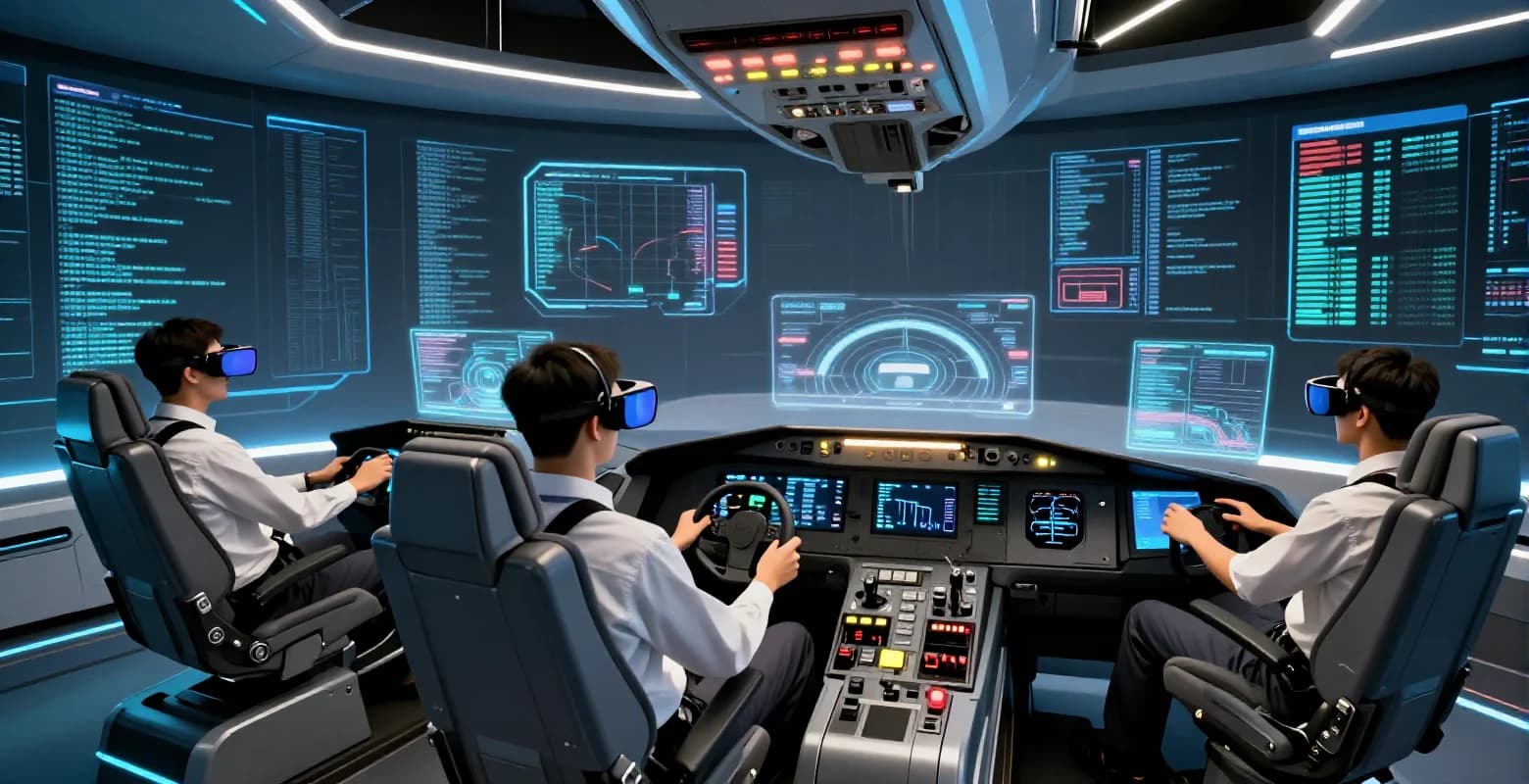
Latest Trends in Pilot Training: VR Simulators and AI are Revolutionizing the Industry
Introduction
Pilot training has always been a cornerstone of aviation safety. Traditional methods, relying on physical simulators and expensive flight hours, are evolving with technological advancements. Over the past decade, we have witnessed a revolution in this field, driven by the development of virtual reality (VR) and artificial intelligence (AI).
According to a report by the International Air Transport Association (IATA), global demand for pilots will increase by 59% by 2037, posing a challenge for the industry to train new cadres efficiently and cost-effectively. Traditional methods cannot keep pace with this tempo - an hour of flight on a passenger aircraft can cost up to $2000, and instructor availability is limited.
VR and AI Revolution in Pilot Training
Flight simulators based on VR technology are becoming increasingly advanced. Companies like CAE and Boeing are investing millions in developing systems that offer not only photorealistic graphics but also haptic feedback, mimicking vibrations and forces acting on a pilot during flight.
A key innovation is the use of AI to generate dynamic training scenarios. Systems such as Boeing's Flight Simulator X react in real-time to a pilot's decisions, simulating unforeseen situations - from engine failure to turbulence. This allows pilots to practice decision-making in conditions similar to reality, without risk to the aircraft or passengers.
Analysis of Impact on the Industry
- Advantages: - Reduction of training costs by up to 70% compared to traditional methods - Ability to repeat complex maneuvers without time limitations - Personalization of the training path through AI data analysis
- Challenges: - High initial costs of implementing advanced VR systems - Need for software standardization by international aviation agencies - Risk of sensory overload for pilots during long training sessions
- Key Technologies: - Eye-tracking systems for precise VR navigation - Machine learning algorithms to optimize training scenarios - Integration with e-learning platforms for comprehensive theoretical training
- Market Examples: - Asian airlines using VR simulators to train crews in difficult weather conditions - Military programs implementing AI for next-generation air combat simulations - Startups offering subscription models for access to VR training platforms
Perspectives and Challenges
The future of pilot training lies in integrating immersive technologies with traditional methods. Organizations such as the European Aviation Safety Agency (EASA) are working on new regulations that recognize certificates obtained in advanced VR simulators. At the same time, the industry faces the challenge of cybersecurity - training systems must be resistant to hacker attacks that could disrupt real flight in the future.
It is estimated that by 2030, up to 60% of pilot training hours will be conducted in a virtual environment. However, it will be crucial to maintain a balance between technical training and soft skills development - communication within the crew or stress management, which are still best shaped in physical conditions.
Conclusions
The evolution of pilot training is an example of how digital technologies can revolutionize traditional industries. While VR and AI significantly lower barriers to entry for new aviation enthusiasts, the real challenge remains creating a cohesive training ecosystem that combines the benefits of the virtual world with the irreplaceable experience of real flight. The future belongs to those training centers that will adapt these innovations fastest, while maintaining the highest safety standards.