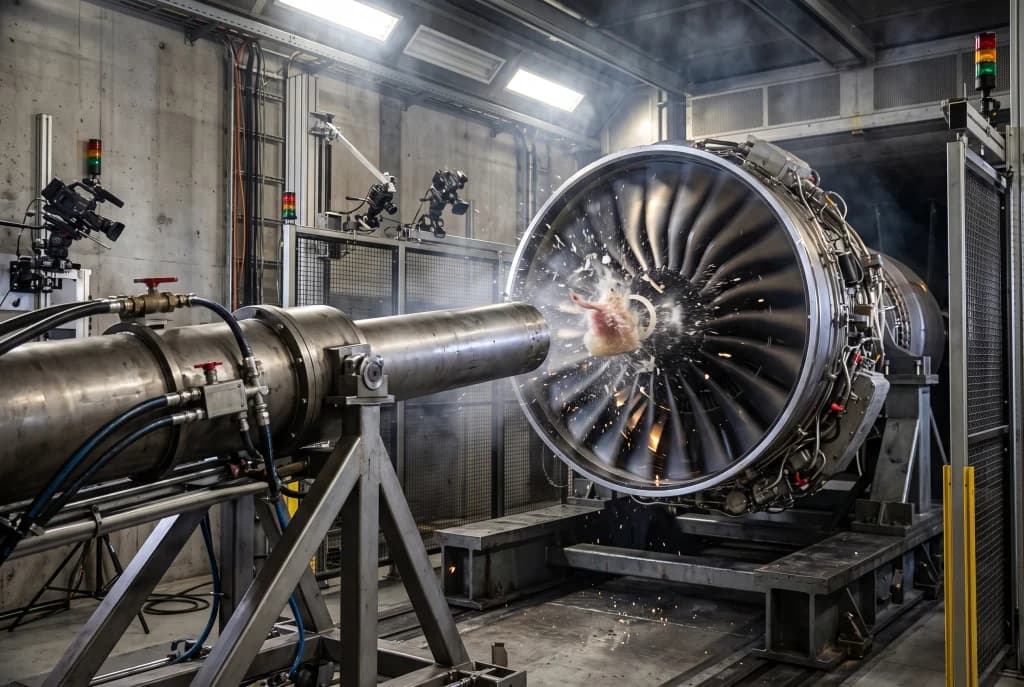
Bird Strikes and the Chicken Gun: How Jet Engines Are Tested for Impacts
Introduction: When Titanium Wings Meet Feathered Wings
For a passenger seated comfortably in the cabin of a modern jetliner, the high-bypass turbofan slung beneath the wing epitomizes mechanical reliability and engineering poise. Its steady, low-frequency hum accompanies every journey, rarely inviting doubt about structural resilience. Yet moments after rotation or descending through terminal airspace, a transport aircraft enters a zone governed for millions of years by avian flight. The operational encounter known across the industry as a bird strike represents one of the most violent, instantaneous, and unpredictable stress tests confronted by aeronautical engineering.
When an airliner accelerating to 250–300 km/h intercepts a flock of birds, two distinct realms of classical physics collide. Within milliseconds, the kinetic energy delivered by a multi-kilogram bird matches the ballistic impact of low-caliber artillery ordnance. How fan blades spinning at several thousand revolutions per minute—machined from titanium alloys and layered carbon composites—withstand such concentrated force without catastrophic disintegration comes down to strict certification frameworks and one of aviation's most curious laboratory instruments: the pneumatic gas cannon colloquially designated the chicken gun.
Impact Physics: Why a Small Bird Represents a Destructive Threat
To grasp the engineering challenge facing propulsion manufacturers such as CFM International, Pratt & Whitney, Rolls-Royce, and GE Aerospace, one must look directly at classical mechanics. The decisive parameter is kinetic energy ($E_k$), which scales linearly with projectile mass but exponentially with the square of relative impact velocity:
When an aircraft rotates and climbs out at an indicated airspeed of 150 knots (roughly 280 km/h) into the path of a Canada goose weighing between 4 and 6 kg, localized shock loading against the fan blade leading edge reaches dozens of tons. Furthermore, blade tips on wide-diameter modern turbofans (such as the GE9X or Trent 1000) rotate at tangential velocities approaching or exceeding the speed of sound. The resulting relative collision velocity is staggering.
At these velocities, an avian body behaves hydrodynamically: under intense stagnation pressures, biological tissues and skeletal structures undergo fluidization, behaving essentially like an ultra-dense, pressurized fluid jet. If a fan blade sustains severe plastic deformation, structural fracture, or tears away at the root, the engine enters a Fan Blade Off (FBO) failure mode. The liberated blade transforms into a high-energy missile that must be securely contained within the nacelle casing.
Origins and Evolution: From Gunpowder Barrels to Pneumatic Cannons
Aviation has contended with wildlife hazards since its inception. The earliest documented bird strike was recorded by Orville Wright in his flight log in 1905. However, during the early decades of low-speed piston-engine flight, low kinetic energy meant collisions rarely compromised primary airframes.
The turning point arrived with the widespread adoption of high-speed turbojet and turboprop airliners. On October 4, 1960, an Eastern Air Lines Lockheed L-188 Electra encountered a dense flock of European starlings immediately following takeoff from Boston Logan International Airport. Starlings ingested into three of the four turboprop engines caused simultaneous power loss, inducing a rapid aerodynamic stall and fatal crash that claimed 62 lives. The accident investigation established a clear regulatory mandate: turbine engines and forward-facing flight surfaces required proven physical impact tolerance before carrying passengers.
Initial impact simulations employed modified military powder guns, but these offered little control over muzzle velocity and damaged test articles prematurely. During the 1960s and 1970s, engineers at the United Kingdom's Royal Aircraft Establishment (RAE) and Canada's National Research Council (NRC) engineered specialized compressed-gas simulators—formalized as the Flight Impact Simulator, known colloquially as the chicken gun. This equipment standardized testing for cockpit windshields, wing leading edges, and turbofan inlet faces.
How the Chicken Gun Works: Anatomy of a Pneumatic Launcher
Far from a makeshift workshop pipe, an industrial impact simulator is a dedicated pneumatic ballistics installation operated under tight laboratory tolerances. A standard simulator installation comprises several key sub-assemblies:
- High-Pressure Reservoir (Pressure Vessel): A reinforced steel pressure chamber loaded with compressed dry air or nitrogen charged to several dozen bar.
- Fast-Acting Diaphragm Valve: The release core of the launcher. Actuating in single-digit milliseconds, it dumps the pressurized reservoir volume behind the projectile without throttling losses.
- Calibrated Smooth-Bore Barrel: A precision-honed steel launch tube ranging from 10 to over 20 meters in length, with inner bore diameters scaling up to 300–400 millimeters.
- Sabot Assembly: A lightweight foam or polymer carrier cup that encases the organic or synthetic projectile, forming an airtight bore seal during pressurization.
- Sabot Stripper: A heavy-duty mechanical collar fixed at the muzzle that arrests and separates the carrier cup, allowing only the projectile to continue downrange toward the target.
The Projectile Dilemma: Frozen vs. Thawed
A widely circulated aviation myth—frequently recounted across flight lines and engineering lore—alleges that a test facility once borrowed a chicken gun to validate high-speed train or aircraft windshields, loaded a supermarket-frozen bird, and shattered the entire structure, prompting engineers to advise: "Defrost the chicken."
While the story is apocryphal, it highlights a crucial point of scientific methodology: certification trials strictly forbid the use of frozen carcasses. Solid ice acts as an unyielding kinetic penetrator, yielding non-representative shearing forces. Regulatory standards from the FAA and EASA specify projectile weight, temperature, and condition: organic test carcasses must be fully thawed, fresh, and conditioned to ambient room temperature to ensure correct hydrodynamic deformation upon impact.
In modern laboratories, traditional poultry is increasingly supplanted by standardized synthetic gelatin and polymer projectiles. Engineered to exact densities and shear strengths, these calibrated artificial surrogates eliminate ethical concerns while delivering repeatable hydrodynamic loading profiles across consecutive test firings.
Regulatory Rigor: FAA and EASA Airworthiness Benchmarks
Aviation safety directives codified under US FAR Part 33 (Federal Aviation Regulations) and European CS-E (Certification Specifications for Engines) define precise pass/fail criteria. For a commercial turbofan to earn type certification, it must complete standardized ingestion trials on an outdoor test cell.
The Three Certification Ingestion Regimes
- Single Large Bird (SLB): Evaluates the ingestion of a single large bird weighing between 1.8 kg and 3.65 kg (scaled relative to engine inlet throat area). The projectile is fired directly into the most critical aerodynamic section of the fan rotor at maximum Takeoff Thrust. The turbofan is not required to remain operational post-impact, but it must demonstrate a contained, safe shutdown—no uncontained casing rupture, nacelle fire, structural pylon failure, or engine detachment may occur.
- Flock of Medium Birds: Simulates an encounter with gulls or waterfowl (individual masses from 0.7 kg to 1.15 kg). The engine must demonstrate operational survivability: following multi-target ingestion, the powerplant must maintain at least 50% to 75% of rated takeoff thrust for a specified duration (typically 14 to 20 minutes), preserving sufficient power for a safe airport diversion.
- Flock of Small Birds: A high-cadence burst of numerous smaller birds (such as starlings) directed into the core intake. The engine must absorb the impact without sustaining compressor stalls, uncontrolled exhaust gas temperature (EGT) spikes, or uncommanded thrust rollback.
Structural Defense: How a Modern Turbofan Absorbs the Impact
During the initial critical milliseconds of an ingestion event, modern high-bypass turbofans rely on tailored aerodynamic and structural design features to mitigate damage.
1. High-Bypass Duct Centrifugal Separation
On modern commercial jetliners, 80% to 90% of the air entering the nacelle never passes through the combustion chamber; it is ducted around the engine core via the bypass duct to generate propulsive thrust. The wide, contoured fan blades act as an aerodynamic centrifuge. Upon impact, the vast majority of biological mass is flung outward into the cold bypass airstream and expelled harmlessly out the back, preventing foreign material from reaching delicate high-pressure compressor stages.
2. Advanced Blade Metallurgy and Composites
Legacy turbofans utilized solid forged titanium blades, which were heavy and prone to permanent bending. Modern wide-chord designs employ 3D-woven carbon-fiber composite blades reinforced with a solid titanium leading-edge sheath (pioneered by GE on the GE90). The composite substrate flexes elastically to dissipate dynamic shock, while the bonded titanium edge prevents delamination and structural notch tearing caused by localized contact.
3. Containment Rings: The Armor of Last Resort
If an impact is severe enough to fracture a blade root, the surrounding engine nacelle must contain the fragments. The fan casing is wrapped in a heavy-duty Kevlar containment ring—the same ballistic material utilized in body armor—sandwiched between composite and titanium bands. The containment ring is engineered to absorb the kinetic energy of a severed blade moving at ballistic velocity, keeping debris inside the nacelle to safeguard passenger cabins, hydraulics, and fuel cells housed within the wings.
The Miracle on the Hudson: A Real-World Ingestion Benchmark
The definitive test of dual-engine foreign object ingestion occurred on January 15, 2009, with US Airways Flight 1549. Climbing out of New York’s LaGuardia Airport, an Airbus A320 flown by Captain Chesley "Sully" Sullenberger and First Officer Jeffrey Skiles struck a dense flock of migratory Canada geese at an altitude of approximately 2,800 feet.
Individual birds in the flock weighed an estimated 4 to 5 kg, far exceeding the regulatory envelope for medium flocking ingestions. The birds entered both CFM56-5B powerplants simultaneously, extinguishing combustion in both cores. Yet, the airframe and engines performed precisely as structural safety rules intended: neither engine suffered structural casing failure, no wing fuel tanks were compromised, and no nacelle fires erupted. Preserving full fly-by-wire flight control authority enabled the flight crew to execute an unpowered ditching onto the Hudson River, saving all 155 passengers and crew aboard.
Modern Prevention: Avian Radars and Supercomputer Simulations
Physical testing with the chicken gun is now supported by advanced computational workflows. Long before hardware is positioned downrange, finite element modeling (FEM) and computational fluid dynamics (CFD) simulate thousands of virtual impacts.
Digital engine models allow stress engineers to examine localized shock waves and structural strain across individual blade plies down to nanosecond intervals. Physical firing tests now serve primarily as final regulatory validation for baseline digital engineering models.
At the operational level, international hub airports deploy specialized Avian Radar Systems capable of tracking flock movements within terminal airspace in real time. Combined with runway wildlife control, bioacoustic dispersal devices, and trained falcons, ground-based prevention works continuously to minimize the likelihood that an aircraft engine must rely on its physical containment engineering in flight.
Conclusion: An Invisible Shield Along the Route
Bird strikes remain an inherent reality of operating in the lower atmosphere, and no operational countermeasure can eliminate wildlife encounters entirely. However, the rarity of hull losses from these events reflects decades of engineering discipline and structural validation.
The pneumatic chicken gun—unconventional though it sounds—has validated materials that have protected countless passengers over the past half-century. The next time you glance out a cabin window during rotation at the massive turbofan beside you, remember: that nacelle and its rotor were proven in specialized facilities to endure the most demanding environmental impacts the sky can present.