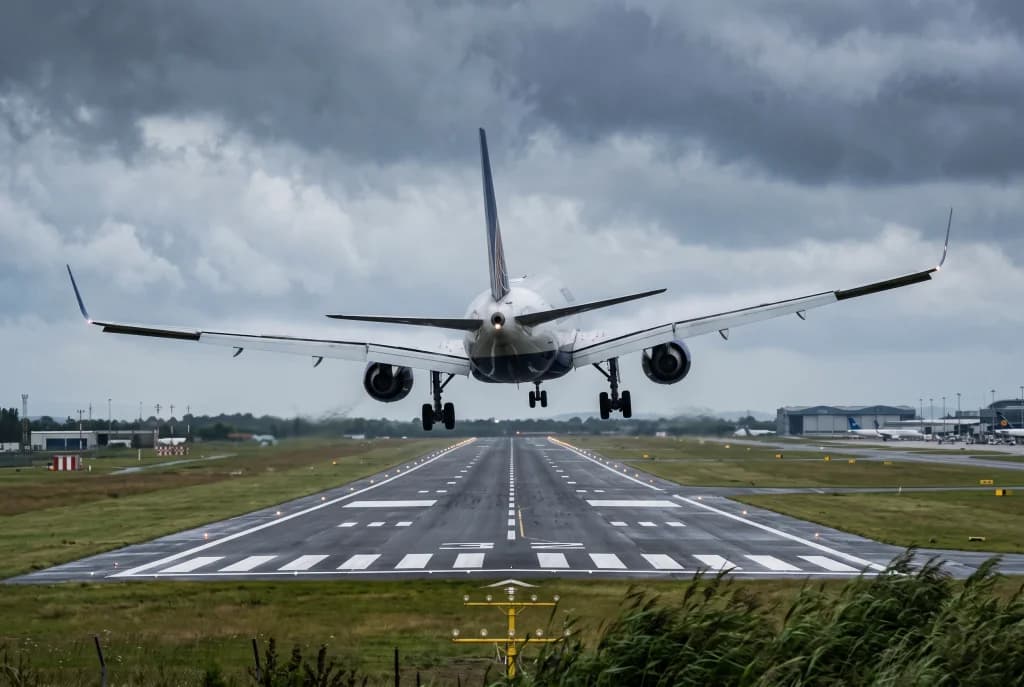
Crosswind Landing: How Pilots Master the Crab Technique
Introduction: When the Runway Veers Off to the Side
You are sitting by the window of a commercial jetliner just a few hundred feet above the terrain. The moment of landing is approaching, extended flaps generate a low-frequency hum of rushing airflow, and the familiar contours of airport ground installations emerge below. You glance ahead and notice something that can trigger an instant adrenaline surge for an uninitiated flyer: the concrete ribbon of the runway is not aligned squarely in front of the aircraft's nose, but sits offset, visible diagonally through the cockpit's side glazing. The aircraft appears to be drifting sideways across the approach axis, contending with wind gusts that toss an airframe weighing dozens of tons like a balsa glider.
This is neither a loss of directional control nor a navigational error. It is crabbing—known in aeronautical terminology as the crab technique or establishing a crab angle. It stands among the most visually striking, demanding, and precise maneuvers in commercial aviation. Executing it requires flight crews to orchestrate aerodynamic principles, airframe inertia, and cross-controlled flight inputs within fractions of a second over the runway threshold. How do airline pilots tame heavy air masses attempting to blow the aircraft off the extended centerline, and what separates a smooth touchdown from an immediate go-around?
The Physics of a Crosswind: The Component That Alters Flight Paths
Wind direction and velocity are critical operational parameters throughout flight, but they become paramount during final approach. When calculating descent metrics, pilots analyze the resultant wind by resolving it into two primary geometric vectors: headwind or tailwind, and the crosswind component.
An aircraft in flight possesses no physical friction contact with the terrain below; it moves within a dynamic body of air. If that air mass travels perpendicular or diagonally across the active runway, the aircraft is subjected to aerodynamic drift. If a pilot kept the aircraft's longitudinal heading aligned with the painted centerline, the lateral wind component would blow the jet off the runway profile in seconds, right into airport perimeter turf or terminal obstacles.
To keep the actual flight path over the ground (Track) locked onto the runway centerline extended, the crew must orient the longitudinal axis of the aircraft directly into the wind. The angular difference between the aircraft’s magnetic heading and its ground track is the drift angle, managed manually by establishing the crab angle. This follows elementary vector mathematics: the forward airspeed component oriented into the wind must cancel out the perpendicular velocity of the arriving air mass.
Anatomy of the Crab Technique
Modern airline training programs instruct crews in two primary methods for managing crosswind arrivals: the crab technique and the sideslip (or wing-low) technique. The vast majority of heavy transport airliners—from twinjet families like the Airbus A320 and Boeing 737 to widebodies like the Boeing 777 and Airbus A350—fly the initial and intermediate approach phases utilizing the crab method.
Why the Crab Technique Is Preferred on Approach
- Aerodynamic Symmetry: While established in a crab, the aircraft’s wings remain level relative to the surrounding airflow, and the slip-skid indicator remains centered. The aircraft flies without lateral slip, boundary-layer airflow over the fuselage and wings remains symmetrical, and parasitic drag does not spike.
- Passenger Comfort: Cabin occupants experience no sustained lateral G-forces or continuous roll angles while descending along the instrument landing system (ILS) glideslope.
- Engine Nacelle Ground Clearance: Modern airliners mount large high-bypass turbofan engines under the wings on low-slung pylons. Banking an aircraft close to the runway surface introduces the risk of striking an engine nacelle against the tarmac (Engine Nacelle Strike). The crab technique keeps the wings completely level down the entire final descent path.
Crossing the Threshold: Dynamic Adjustments
Descending down the electronic glideslope, the pilot flying (PF) continually modulates the crab angle. As altitude decreases, the wind vector typically shifts direction and loses velocity due to friction within the planetary boundary layer. This means the crab angle is dynamic: it might measure 15 degrees at 1,000 feet, gradually relaxing to 7 degrees over the threshold.
Approach speed must also be adjusted for atmospheric conditions. To the baseline approach speed $V_{\text{APP}}$, derived from gross landing weight and flap configuration, flight crews add a calculated wind additive—typically one-third to one-half of the steady headwind component plus the full gust value. This additional kinetic energy protects the wing against unexpected stall margins caused by sudden wind shear or convective downdrafts.
The Decisive Instant: De-Crabbing Over the Threshold
While flying crabbed through the air is aerodynamically efficient, setting the landing gear down obliquely to the runway pavement would exert severe mechanical stress on the airframe. If tires touched down while oriented 15 degrees off-axis at 250 km/h, the tread would scrub violently, and the main landing gear trucks would absorb destructive side loads that could damage the gear structural mountings or induce a runway excursion.
For this reason, the critical transition occurs in the final seconds before wheel spin-up: the de-crab maneuver.
Split-Second Flight Control Coordination
At a radar altitude between 30 and 10 feet (roughly 9 to 3 meters above the asphalt), the flying pilot initiates the flare and the de-crab simultaneously:
- Rudder Input: The pilot applies downwind rudder to yaw the nose and align the aircraft's longitudinal axis parallel to the painted runway centerline. The nose swings into the runway track.
- Aileron Compensation: When the aircraft yaws straight, the upwind wing advances faster into the relative wind, generating localized lift, while the broadside of the fuselage catches the crosswind. To prevent the jet from drifting laterally off the centerline and to stop the upwind wing from lifting, the pilot applies opposite aileron, rolling the control wheel or sidestick into the wind.
- Touchdown on the Upwind Gear: As a result of cross-controlling, the aircraft contacts the runway in a slight wing-low attitude: the upwind main gear tires make contact first, followed milliseconds later by the downwind tires, and finally the nose gear settles onto the centerline.
Design Variations: Boeing vs. Airbus Philosophy
Crosswind management differs depending on the flight deck interface and fly-by-wire architecture of the aircraft type. Differing flight control systems dictate specific operating procedures.
Airbus: Fly-by-Wire Architecture and Flight Control Laws
Aboard the Airbus A320 and A330 families, the Fly-by-Wire architecture functions under Normal Law throughout flight. Under this design, the pilot's sidestick commands roll rates and load factors (G-Load) rather than raw surface deflections, with auto-trim handling pitch attitude.
Passing 50 feet radio altitude, however, the flight control computers seamlessly transition to Flare Mode, introducing direct-stick feel characteristics akin to Direct Law. This provides the pilot with conventional manual feedback. Airbus procedures prescribe maintaining a pure crab down to flare height before initiating the de-crab. Additionally, Airbus main landing gear assemblies are certified to absorb residual crab angles (up to 5 degrees) on touchdown, meaning minor residual yaw is handled by the mechanical compression of the gear shock struts.
The Boeing 777 and Seattle's Widebodies
Aboard the Boeing 777, pilots manipulate conventional interconnected control yokes, supported by robust landing gear engineering. The massive, six-wheel main gear bogies are engineered to withstand substantial lateral loads. Boeing's Flight Crew Training Manual (FCTM) specifically allows for a touchdown in a crab on contaminated or wet runways: the aircraft can touch down with a remaining crab angle, as reduced tire friction on wet concrete allows the gear to slip laterally and align the aircraft automatically with the runway vector without excessive side-load stress.
By contrast, the historic Boeing B-52 Stratofortress bomber uses crosswind-crab landing gear: the pilots can mechanically cross-steer all main landing gear bogies up to 20 degrees relative to the fuselage centerline, allowing the airframe to touch down fully crabbed while the tires track straight along the runway.
Operating Limits: Defining the Safety Margin
Aviation is an exercise in precise risk mitigation, and every airframe type operates within certified performance parameters. A key metric is the Demonstrated Crosswind Limit.
The demonstrated crosswind figure is not strictly an airworthiness limit (unless an airline's internal Operations Manual explicitly designates it as an absolute ceiling), but rather the maximum steady crosswind value verified by test pilots during certification trials under severe conditions (such as at Keflavík Airport in Iceland). Typical dry-runway demonstrated figures include:
- Airbus A320: 33 knots (gusting up to 38 knots on dry surfaces),
- Boeing 737-800: 34 knots,
- Boeing 777-300ER: 45 knots.
These maximum values decrease significantly when a runway is wet, snow-covered, or contaminated with slush and ice. On an icy surface, the allowable crosswind limit can drop to just 10 to 15 knots. Under those conditions, minimal tire friction cannot counter the weathercocking effect—where crosswinds act on the vertical stabilizer to swing the tail and push the aircraft off the runway.
The Go-Around: The Ultimate Safety Tool
When an approach becomes unstabilized, an erratic gust blows the aircraft off centerline, or the necessary crab angle exceeds rudder control authority, the proper operational decision is to initiate a go-around (missed approach).
Passengers often interpret the sudden spool-up of jet engines to takeoff/go-around power (TOGA) and a steep climb away from the ground as an emergency. In reality, it is a routine, well-drilled flight maneuver executed to maintain safety. The decision to execute a missed approach can occur at any time prior to thrust reverser deployment. If crosswinds at the destination persist outside operational safety limits, the captain will divert the flight to an alternate airport.
Conclusion: Engineering and Airman Craft
Landing in heavy crosswinds using the crab technique highlights the synergy of flight dynamics and crew precision. It brings together the realities of atmospheric physics with the manual skill required to control a complex transport aircraft. Every clean touchdown in gusty weather is supported by hours in Full Flight Simulators (FFS), standardized airline operating procedures, and practiced cockpit crew coordination.
The next time you look through a cabin window on final approach and spot the runway positioned off to the side, you can relax in your seat. The aircraft is not off course—it is executing a managed crosswind approach, handled by professional pilots trained to operate safely in challenging conditions.