What Happens to Your Luggage at the Airport? The Journey from Check-In to Hold
Introduction: The Disappearing Act at the Check-In Desk
You place your suitcase onto the scale at the check-in counter or the automated Self-Bag Drop station. An agent tags your luggage with a long, adhesive barcode strip, presses a button, the belt engages, and your bag glides through the rubber-flapped opening set into the terminal wall. For most passengers, this marks a clean break: the suitcase effectively ceases to exist for the next ten or twelve hours, only to reappear—ideally intact—on a baggage carousel in Tokyo, New York, or Madrid. Travelers often picture a straightforward journey: a baggage handler loading bags onto a cart and driving them straight out across the apron to the waiting aircraft.
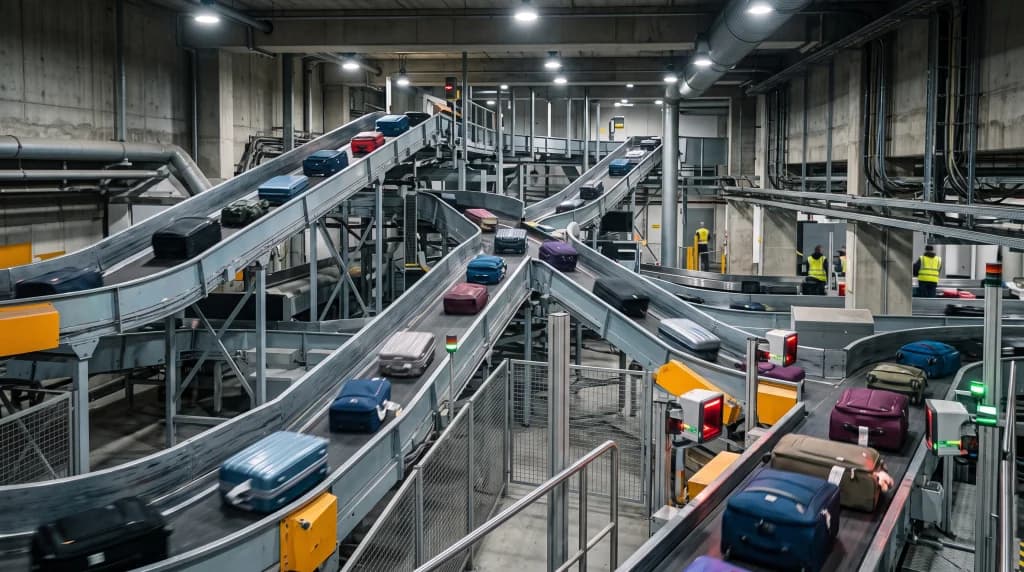
The operational reality beneath the terminal floor is an extraordinary engineering accomplishment. Behind that stainless-steel wall lies no cluster of handlers waiting around the corner. Instead, a sprawling, multi-tiered subterranean industrial complex unfolds: the Baggage Handling System (BHS). This automated subterranean facility features miles of high-speed conveyor belts, tilt-tray sorters, vertical spiral lifts, and linear-motor rail networks stretching from a dozen to nearly one hundred kilometers across major international megahubs such as Frankfurt, Dubai, or London Heathrow. In this subterranean maze, your suitcase undergoes an intensive, automated journey spanning just fifteen minutes from curb to cargo hold.
Within this secured envelope, operations are orchestrated to the millisecond, guided by industrial programmable logic controllers and automated sorting algorithms. Tracing routes at speeds up to 30 to 40 km/h, bags pass through computed tomography explosives detection scanners, optical sensor arrays, and barcode scanning tunnels before arriving at designated air cargo containers. Step below the ramp surface into the quiet, mechanical world that moves global passenger luggage.
Minute 00: The Bag’s Digital Passport—Anatomy of the IATA Tag
The entire journey hinges on an unpretentious, 40-centimeter strip of thermal paper reinforced with tear-resistant synthetic fibers: the IATA Baggage Tag. Standardized under IATA Resolution 740, this slip serves as your luggage's official digital passport throughout the international air transport network.
The critical element of the tag is not the prominent three-letter destination code (such as JFK or SIN), but the 10-digit barcode encoded in Interleaved 2 of 5 or Code 128 formats:
- First digit: Identifies the tag type (for example, 0 denotes standard checked passenger baggage; 1 indicates automated interline transfer baggage).
- Next three digits: The airline’s three-digit numeric IATA accounting prefix (e.g., 080 for LOT Polish Airlines, 220 for Lufthansa, 016 for United Airlines).
- Final six digits: The unique item sequence identifier assigned by the host departure control database, mapped directly to an automated Baggage Source Message (BSM).
Across an increasing number of international hubs compliant with IATA Resolution 753—which mandates continuous baggage tracking across four mandatory operational milestones—these paper tags embed a micro-miniature Radio-Frequency Identification (RFID) inlay. This passive chip and micro-antenna require no optical line-of-sight. While traditional optical barcodes can get folded, torn, or obscured beneath handles, UHF RFID readers capture tag data with read accuracies exceeding 99.8%, even as luggage travels along high-speed conveyors at multiple meters per second.
Minutes 01 to 03: Injection into the Mainstream and the ATR Tunnel
Once cleared from the check-in belt, the suitcase transitions immediately onto a dynamic weigh-in-motion and dimensional profiling section (Volume Measurement System). Here, arrays of infrared light curtains scan the bag's three-dimensional envelope:
- If the suitcase breaches maximum dimensional thresholds (typically 158 linear centimeters), weighs more than 32 kg (the maximum single-item ergonomic lifting limit for ramp personnel), or features loose straps prone to jamming mechanical rollers, the system diverts it to an Out of Gauge (OOG) oversized baggage spur for manual handling.
- If it fits standard parameters, a high-speed merge injector pushes the bag onto the main underground collector trunk line.
The Automatic Tag Reader (ATR) Array
Moving along the collector, the bag enters the Automatic Tag Reader (ATR) array. This portal is ringed by high-speed laser scanners and multi-megapixel CCD area cameras configured in a full 360-degree hexagonal array. Whether the suitcase is upright, on its side, or face-down, omnidirectional laser beams scan every exterior surface through calibrated gaps between conveyor rollers.
The ATR decodes the 10-digit tag string in milliseconds and queries the central BHS supervisory server. The system reconciles the bag tag with the carrier’s live Departure Control System (DCS) database, verifying flight status, assigned gate, departure parking stand, passenger transfer routing, and target Unit Load Device (ULD) container. From that microsecond forward, the suitcase is tracked by a digital twin within the facility's Programmable Logic Controller (PLC) architecture, mapped along every conveyor segment.
Minutes 03 to 07: Subterranean Security Screening (Hold Baggage Screening)
This is the most critical segment of the baggage journey, operating under strict international civil aviation security mandates (ECAC in Europe, TSA in the United States). By law, 100% of checked baggage must undergo multi-tiered screening through the Hold Baggage Screening (HBS) matrix.
Modern hubs have largely phased out conventional dual-energy 2D X-ray systems in favor of high-throughput Standard 3 Explosive Detection Systems (EDS), which utilize industrial-grade Medical Computed Tomography (CT) technology adapted for rapid conveyor transport.
The Five HBS Screening Tiers
- Level 1 (Automated High-Speed 3D CT Screening): The suitcase rolls directly into the rotating gantry of an EDS CT scanner. Rotating at high RPMs, the X-ray tube and detector array capture hundreds of cross-sectional volumetric slices per second, synthesizing a detailed 3D density model. Automated threat detection algorithms assess the physical properties of every object inside, calculating calibrated mass density and effective atomic numbers ($Z_{\text{eff}}$). This allows the system to differentiate between organic food items, dense textiles, and plastic high explosives such as Semtex or C-4. If no threat signatures are detected, the system issues an automated "Level 1 Clear" in 3 to 5 seconds, and the bag continues down the line without manual intervention.
- Level 2 (Remote Operator Image Analysis): If automated algorithms detect an area of interest, the volumetric 3D image is dispatched over an internal fiber-optic network to certified screeners in the central HBS viewing facility. The screener has 20 to 30 seconds to inspect the render: rotating the virtual bag across three axes, stripping away organic layers, isolating metallic components, and analyzing internal structures. If the screener identifies the object as benign (such as a consumer electronics battery pack or power bank), they clear the item, and it returns to the main sorter.
- Level 3 (Senior Image Analysis Specialist): If the Level 2 screener cannot confirm the item's safety within the time limit, the bag diverts into a short holding loop, routing the file to a senior explosives analyst for targeted cross-sectional analysis and density profile evaluation.
- Level 4 (Physical Inspection and Explosives Trace Detection - ETD): Bags that cannot be resolved via digital screening are diverted to a secured physical inspection room. Under continuous CCTV monitoring, security personnel open the bag in the passenger's presence or under strict chain-of-custody protocols. Swabs are taken and analyzed in an Explosives Trace Detector (ETD) ion mobility spectrometer, which can detect explosive particulates down to nanogram thresholds.
- Level 5 (Explosive Ordnance Disposal - EOD): If physical analysis confirms the presence of an explosive device, the affected conveyor line is isolated immediately, the bag is placed into an armored blast containment vessel, and law enforcement explosive ordnance disposal specialists are deployed.
Statistically, more than 95% of checked baggage clears Level 1 screening automatically, exiting the HBS security matrix within four minutes of initial check-in.
Minutes 07 to 11: High-Speed Logistics and Sorting Architecture
Once security-cleared, the suitcase enters the sorting hub. In expansive modern airports, distances between the central terminal and remote satellite concourses often span two to four kilometers underground. Standard flat-belt conveyors operating at 1 to 2 m/s cannot meet the tight connection windows demanded by 45-minute flight transfers. To maintain throughput, hubs utilize specialized high-speed baggage transport networks.
Tilt-Tray vs. Individual Carrier Systems (ICS)
Modern automated baggage distribution systems rely primarily on two mechanical approaches:
- Cross-Belt and Tilt-Tray Sorters: These systems move bags along continuous, high-capacity closed loops. Each bag sits atop an articulated mechanical carrier. As the carrier glides past the designated flight drop chute, the tray mechanically tilts to a 45-degree angle (Tilt-Tray) or activates a localized motorized belt on the carriage (Cross-Belt), discharging the bag down the slide via gravity.
- Individual Carrier Systems (ICS / Tote Networks): Considered the state of the art in baggage automation (utilized in hubs such as Munich, Singapore Changi, and Doha Hamad). Once checked, the suitcase never rests directly on conveyor rollers; it sits inside an individual RFID-tagged polymer carrier (tote). These totes glide along low-friction guide rails propelled by Linear Synchronous Motors (LSM) at speeds of 36 to 40 km/h, banking through turns like an automated miniature roller coaster. By isolating the suitcase inside the tote, mechanical jams, snagged straps, and wheel damage are virtually eliminated.
Early Bag Storage (EBS): The Automated Underground Warehouse
When travelers check bags six hours ahead of departure or arrive on extended interline connections, their luggage cannot be sent directly to the makeup chutes, where it would congest ramp staging areas. Instead, the BHS directs these items into an Early Bag Storage (EBS) facility—a fully automated, high-bay storage warehouse deep underground.
Inside the EBS, automated robotic crane systems retrieve totes and park them in high-density shelving arrays that hold tens of thousands of bags. Each item remains cataloged within the facility's supervisory database under continuous monitoring. Approximately 90 minutes prior to scheduled departure, the system retrieves the specific tote and injects it back into the main distribution stream toward the active loading area.
Minutes 11 to 15: The Make-Up Area, ULD Containers, and Ramp Operations
Approaching the eleventh minute, the suitcase descends through a spiral steel chute into the operational staging floor: the Make-Up Area. Here, automated routing transitions to the physical operations managed by ramp ground handling agents—such as Swissport, dnata, Menzies, or dedicated airline ground teams.
Unit Load Devices (ULD): Modular Cargo Blocks for Wide-Body Aircraft
For long-haul routes flown by wide-body aircraft (such as the Boeing 777, 787, or Airbus A350), individual suitcases are not loaded loose into the cargo hold. Instead, they are packed into standardized, lightweight aluminum air containers called Unit Load Devices (ULDs):
- The standard passenger baggage container is the AKE (LD3)—an aluminum container contoured on one side to match the curved lower-deck fuselage profile of commercial wide-body airliners. A single LD3 container typically accommodates between 30 and 45 pieces of luggage.
- Loading follows a controlled process. As each bag goes into the container, handlers scan its barcode with a ruggedized terminal connected to the carrier’s Baggage Reconciliation System (BRS), digitally linking the piece to that specific ULD and flight position. If an economy or premium passenger fails to board before gate closure, the reconciliation system pinpoints the exact container and its location within the hold. Under international Positive Passenger Baggage Matching (PPBM) security regulations, a flight cannot depart with the checked luggage of a passenger who has not boarded, barring specific authorized unaccompanied baggage screening exemptions.
Bulk Loading: Operations on Narrow-Body Aircraft
On short-to-medium-haul routes serviced by narrow-body airliners (such as the Boeing 737 or conventional Airbus A320 variants), cargo holds generally lack the mechanical roller tracks and dimensions required for containerized ULDs. In these operations, bags coming down the chute are sorted into open baggage carts fitted with heavy-duty weather curtains.
Electric tugs haul these cart trains across the ramp to the waiting aircraft. Ground personnel transfer the luggage onto a mobile belt loader aligned with the cargo door. Inside the lower hold, a ramp agent packs each piece into position by hand, placing heavier hard-shell bags at the base and lighter items on top. Once filled, the hold is secured using rated cargo restraint nets to prevent structural shifting during rotation, turbulent cruise, and landing rollout.
Weight and Balance: How Luggage Placement Affects Flight Performance
Baggage loading involves fundamental flight dynamics and aircraft balance. Every checked item contributes to the aircraft's gross takeoff weight, and the precise weight distribution between cargo compartments—Forward (FWD), Aft (AFT), and the Bulk hold—is routed to the station load controller (Loadmaster) and flight dispatcher.
These weights generate the flight’s legal Load and Trim Sheet. Shifting several hundred kilograms between the forward and aft holds noticeably alters the aircraft’s Center of Gravity (CG). An incorrect loading configuration could compromise rotation during takeoff or degrade aerodynamic stability in flight. In fact, the placement of your suitcase directly influences how the flight crew trims the Trimmable Horizontal Stabilizer (THS) on the tail prior to setting takeoff thrust.
Conclusion: The Mechanics of Modern Air Travel
When you stand beside the baggage carousel at your arrival airport, watching your luggage glide through the rubber flaps minutes after deplaning, you are observing the conclusion of a complex logistics pipeline. Behind that single piece of luggage lies a coordinated system of sensor arrays, automated explosive detection scanners, high-speed routing tracks, and dedicated ramp teams working in all weather conditions.
The next time you see your suitcase disappear behind the check-in curtains, consider the subterranean journey it is about to take. Over the next fifteen minutes, your bag traverses an automated industrial network that helps keep modern commercial aviation safe, organized, and moving on schedule.