Air-to-Air Refueling: Formation Precision at 600 km/h
Introduction: Surgical Precision at 600 km/h
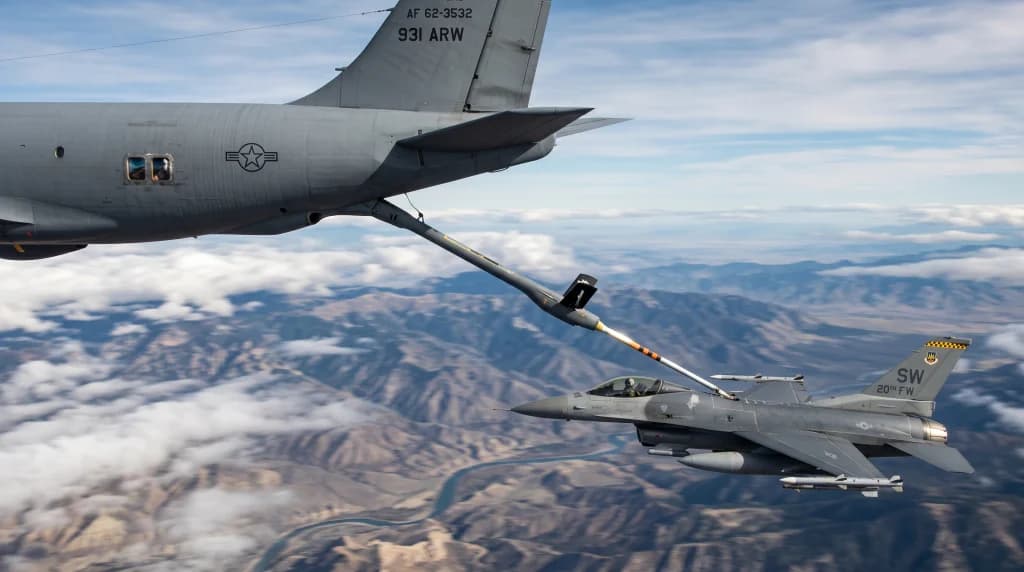
To a passenger looking out the window of a commercial airliner at cruising altitude, the skies appear to be a realm of absolute serenity and endless open space. In the world of military aviation, however, a maneuver takes place at 26,000 feet that defies basic self-preservation instincts. Two heavy aircraft—a tanker weighing nearly one hundred metric tons and an armed, supersonic fighter—close to within mere meters of each other while flying at speeds exceeding 600 km/h. Enveloped in violent aerodynamic wake, sudden gusts, and condensation streaming from wingtips, a metal fuel probe must plug into a receptacle barely the size of a dinner plate.
Air-to-Air Refueling (AAR) is the ultimate test of close formation flying and fluid mechanics. It is an operation where the margin for error is measured in centimeters, and a momentary lapse in focus risks a catastrophic mid-air collision costing hundreds of millions of dollars. Without this capability, modern tactical and strategic airpower would be severely limited: fighters would remain tethered to the short range of their internal tanks, and global missions would demand multiple intermediate stops on foreign soil. What does this aerial ballet look like from the flight deck and the boom pod? How does the American rigid boom compare to the European probe-and-drogue design, and how do aircrews master the aerodynamic forces threatening to push both aircraft apart?
Two Philosophies: Flying Boom vs. Probe-and-Drogue
Global military aviation relies on two distinct air-to-air refueling architectures. The choice between them reflects differences in strategic doctrine, aircraft design, and service branch operational requirements.
1. The Flying Boom: High-Volume Strategic Transfer
The rigid Flying Boom system is the signature method of the United States Air Force (USAF) and operators of aircraft such as the Boeing KC-135 Stratotanker, KC-10 Extender, and KC-46 Pegasus. A rigid, telescoping pipe extends from the empennage of the tanker, fitted with aerodynamic control surfaces—small V-tail airfoils known as ruddervators.
In this system, the fighter pilot does not steer into the fuel line. The receiving pilot (flying an F-16, F-15, or F-35, for example) must fly into a designated geometric space behind and slightly below the tanker—the refueling envelope—and hold the jet in steady formation. At that point, the Boom Operator takes over. Lying prone in the tail pod of a KC-135 or seated before a 3D remote vision console on the KC-46, the operator uses a control stick to fly the boom through the air, steering its nozzle directly into the slipway receptacle on the receiver's fuselage.
The primary advantage of the Flying Boom is throughput: fuel can be pumped under pressure at rates of 3,000 to 4,000 liters per minute for tactical fighters, and up to 8,000 liters per minute when servicing heavy bombers like the B-52 or strategic transports like the C-5 Galaxy. A fighter's fuel tanks can be completely replenished in under three minutes.
2. Probe-and-Drogue: Flexible Naval and European Operations
The flexible hose and drogue system is favored by the US Navy, the French Air and Space Force, the British Royal Air Force, and most NATO nations operating types like the Eurofighter Typhoon, Dassault Rafale, or Saab JAS 39 Gripen. The tanker (such as an Airbus A330 MRTT) unrolls a long, flexible hose from a fuselage station or underwing pod, ending in a funnel-like aerodynamic stabilizer resembling an oversized shuttlecock: the basket (or drogue).
Under this approach, the pilot of the receiving aircraft shoulder the active docking workload. The receiver is fitted with a fixed or retractable probe extending forward of the canopy. The pilot must align and fly the tip of this probe directly into the center of the trailing basket, closing with a relative speed of 3 to 5 knots (approx. 6 to 9 km/h). Insufficient closing speed prevents the latching collets from seating; excessive speed causes hose whiplash, which can strike the canopy, snap the probe, or send debris into the engine intake.
While transfer rates are lower (typically 1,000 to 1,500 liters per minute), this system offers considerable operational flexibility: an A330 MRTT fitted with wing pods can refuel two fighters simultaneously, and tactical fighters equipped with buddy stores (Buddy-Buddy Refueling) can refuel one another without requiring a dedicated strategic tanker.
Aerodynamic Traps Beneath the Tanker
Air-to-Air Refueling requires intense precision because it occurs in a complex flowfield. The massive airframe of a tanker generates aggressive local aerodynamic disturbances that receiver pilots must counter through manual stick inputs and fly-by-wire flight controls.
1. Engine Jet Wash
The tanker’s high-bypass turbofans discharge thousands of kilograms of exhaust gas per second. Drifting into this wake risks severe rolling upsets, compressor stalls from disrupted inlet airflow, or loss of control. Receivers must establish and maintain their approach profile strictly beneath and behind the engine exhaust streams.
2. Wake Turbulence and Downwash
A heavy wide-body creates strong wingtip vortices and downwash. As a fighter closes on the tanker's tail, it first encounters an area of increased downward airflow, requiring a higher angle of attack and added engine power. Once tucked underneath the tanker's belly, the aircraft enters a localized acceleration zone that creates a bow-wave interaction, tending to push the fighter's nose downward or laterally.
3. The Bow Wave Effect
This is the most challenging dynamic in probe-and-drogue operations. As the receiver’s nose nears the free-trailing basket, high-pressure air preceding the fighter pushes the lightweight drogue outward. At a distance of less than a meter, the basket can suddenly drift off-target. Experienced pilots know the final approach demands a deliberate, committed push of the throttle—hesitation guarantees a missed contact and requires a reset.
The Step-by-Step Refueling Sequence
In-flight refueling operations follow standardized NATO doctrine (ATP-3.3.4.2). Every phase has dedicated terminology, and strict radio silence (EMCON) often requires communication using lights alone.
Step 1: Join-Up
The tanker orbits in an assigned block of airspace known as an Air Refueling Track or Orbit. Receivers locate the tanker using onboard air-to-air radar modes and TACAN (Tactical Air Navigation) ranging. The receiver flight approaches along the tanker's left side, settling into the Observation Position (Echelon Left). The flight lead visually verifies receiver configurations, and pilots open fuel receptacle doors or extend their probes.
Step 2: Pre-Contact Position
Cleared by radio call or signaling lights, an individual fighter smoothly moves into the Pre-Contact Position: approximately 15 meters directly behind the boom or drogue. Here, the pilot trims the airframe and matches airspeed to within a fraction of a knot, establishing synchronized formation flight.
Step 3: Director Lights
In a rigid-boom setup, the receiver pilot cannot see the receptacle on their own fuselage spine or the boom descending above them. Alignment is guided by Pilot Director Lights (PDL) installed on the belly of the tanker. These dual light strips display directional cues:
- One strip indicates Elevation (Up and Down: U/D).
- The other strip indicates Telescoping range (Forward and Aft: F/A).
Centering the green indicator lights on both axes places the fighter squarely in the center of the refueling envelope, allowing the boom operator to make contact.
Step 4: Contact and Offload
The boom operator flies the nozzle into the receptacle. Hydraulic latches in the receiver slipway clamp down with several kilonewtons of force, securing the physical seal, while a cockpit indicator illuminates CONTACT.
Pressurized aviation kerosene (such as JP-8 or F-34) flows through the transfer conduit. For the receiver pilot, this begins the most demanding phase: holding formation for 180 to 240 seconds. As several tons of fuel fill the tanks, the aircraft's gross weight increases significantly. The heavier jet requires more lift and produces higher drag, demanding steady, incremental throttle advances and continuous micro-corrections on the stick to counter ambient turbulence.
Step 5: Disconnect
Once the scheduled fuel offload is reached, the flow ceases, line pressure bleeds off, the latches release, and the boom retracts. If the fighter drifts toward the boundary of the safe envelope, an automatic disconnect triggers instantly to avoid bending or shearing the hardware. The receiving pilot dips slightly to clear the tanker and moves to the right wing (Echelon Right), opening the contact position for their wingman.
Adverse Weather, Night, and Radio Silence
While daytime refueling in clear skies is demanding, combat operations often introduce severe operational friction:
1. Instrument Meteorological Conditions (IMC)
Inside heavy cloud layers or turbulence, pilots lose all external visual horizons, triggering vestibular illusions. The pilot's sole visual cues are the formation lights on the tanker's dark belly hovering meters away. The pilot must fix their gaze on the director lights; glancing out into the surrounding gray soup can cause immediate spatial disorientation.
2. EMCON Procedures: Silent Operations
In combat zones, missions often operate under EMCON 1 (Emission Control Level 1), which prohibits radio transmissions. Calls such as "Clear to contact" or "Disconnect" are eliminated. All signaling is performed using exterior lighting codes and subtle aircraft movements. Pilots execute the hookup relying entirely on muscle memory, standardized procedures, and mutual trust.
3. Night Vision Goggles (NVG)
Operating with night vision goggles eliminates binocular depth perception and renders the visual field in flat, monochrome shades. The intense glow of tanker floodlights can overwhelm NVG tubes, causing blooming. Hooking a probe into a moving basket under these conditions demands hundreds of hours of simulator and operational currency.
Cockpit Psychology and Human Factors
Even seasoned fighter pilots experience elevated heart rates—often 160 to 180 beats per minute—during initial refueling qualifications. Human survival instincts resist flying close to a larger aircraft at high speed. Closing to within three meters of a heavy jet naturally prompts an urge to back off the throttles and break away.
A primary risk during the contact phase is Pilot Induced Oscillation (PIO). Overreacting to minor turbulence can introduce a phase lag between pilot control inputs and the aircraft's aerodynamic response. The pilot ends up feeding control deflections out of phase with the aircraft's motion, causing dangerous pitching or rolling divergence. Overcoming this requires a "light touch"—controlling the fighter with fingertip pressure on the stick, allowing fly-by-wire control laws to dampen small atmospheric disturbances naturally.
Automation and the Future: Unmanned Tankers
In-flight refueling technology is moving toward automated and autonomous architectures. Airbus has qualified the A3R (Automatic Air-to-Air Refueling) system on the A330 MRTT. Using high-resolution optical cameras, LiDAR sensors, and computer vision tracking, the system automatically flies the boom directly into the receiver receptacle with minimal operator intervention.
At the same time, the US Navy has deployed the carrier-based MQ-25 Stingray unmanned aerial tanker. This autonomous drone extends the operational strike range of carrier air wings—servicing F/A-18E/F Super Hornets and F-35Cs—without risking additional tanker flight crews in contested airspace.
Conclusion: The Linchpin of Modern Airpower
Air-to-Air Refueling is a defining discipline of modern military aviation. It brings together fluid mechanics, fly-by-wire engineering, and high-stakes piloting at a single mechanical junction. The moment the nozzle locks into place, two separate aircraft operating at high subsonic speeds function as a single unit, linked by a pressurized lifeline.
Without the range and endurance provided by aerial refueling, long-range tactical air operations would be impossible. This demanding aerial operation ensures that mission range is limited not by fuel capacity, but by the physical endurance of the aircrews at the controls.