Fifth Freedom Flights in Europe: Fly Long-Haul Wide-Bodies on Short Hops
Introduction: An Exotic Wide-Body on a One-Hour Hop Across the Alps
For most European air travelers, short-haul flying across the Old Continent is synonymous with monotony, tight seat pitch, non-reclining slimline seats, and the ubiquitous low-cost business model. You step aboard an Airbus A320 or Boeing 737, wedge your knees into the back of the seat in front of you, and pay the price of a proper meal for a paper cup of black coffee or a bottle of mineral water. Yet at those exact same European airports, often parked immediately adjacent to the yellow-and-blue or orange liveries of budget carriers, sit double-decker Emirates Airbus A380s, sleek Singapore Airlines Boeing 777-300ERs, and ultra-modern Boeing 787 Dreamliners operated by premier Asian and Middle Eastern airlines.
Many travelers assume that boarding one of these flying flagships demands an intercontinental visa, thousands of euros, and the prospect of a twelve-hour haul halfway around the globe. That assumption is completely mistaken. Civil aviation law includes a mechanism that allows an ordinary traveler to board in Milan and step off in Barcelona, fly from Athens to Cyprus, or hop from Switzerland to Italy aboard a wide-body aircraft operated by one of the world's most acclaimed carriers—often for less than the price of a high-speed train ticket. That mechanism is the Fifth Freedom of the Air: a legal provision originating in Chicago in 1944 that aviation enthusiasts and savvy flyers leverage to experience long-haul luxury on short-haul hops at a fraction of the customary fare.
Geopolitics of the Skies: The Origin of Aviation Freedoms
To understand why a Singaporean or Ethiopian airliner has the legal authority to board a local passenger in Milan, fly them to Barcelona, and issue a fully valid boarding pass for that intra-European segment, one must look back to November 1944. Delegates from 54 nations convened at the Stevens Hotel in Chicago to negotiate the post-war framework for international skies. The resulting Chicago Convention established the International Civil Aviation Organization (ICAO) and codified the Freedoms of the Air—a framework of commercial privileges governing an airline's right to enter and land within foreign airspace.
The first four freedoms establish the baseline mechanics of regular international traffic:
- First Freedom: The privilege to overfly foreign territory without landing (e.g., an aircraft en route from Warsaw to Madrid transiting German airspace).
- Second Freedom: The privilege to land in a foreign state for purely technical purposes—such as refueling or unscheduled maintenance—without embarking or disembarking revenue passengers (a technical stop, historically common at refueling hubs like Shannon or Gander).
- Third Freedom: The commercial right to fly revenue passengers and cargo from the airline’s home country into a foreign country (e.g., carrying passengers originating in Warsaw and terminating in Paris on a Polish carrier).
- Fourth Freedom: The inverse of the third—the right to pick up revenue traffic in a foreign country and transport them back to the airline’s home country (e.g., the same aircraft carrying passengers from Paris back to Warsaw).
The Fifth Freedom, however, became the commercial crown jewel—and historically the most fiercely contested chip in bilateral air service negotiations.
The Anatomy of the Fifth Freedom: The Three-Nation Equation
According to the formal ICAO definition, the Fifth Freedom of the Air is the right granted to an airline based in Country A to carry revenue traffic (passengers, mail, and cargo) between Country B and Country C, provided that the flight originates or terminates in Country A.
Consider a practical operational example: Singapore Airlines (Country A) operates long-haul flight SQ378 from its global hub at Singapore Changi Airport to Milan-Malpensa in Italy (Country B). After touchdown in Milan, the aircraft deplanes passengers bound for northern Italy, takes on fuel, and continues forward to Barcelona-El Prat in Spain (Country C). Without Fifth Freedom traffic rights, the airline would only be legally permitted to fly passengers between Singapore and Milan, or transit continuing Singapore-originating passengers onward to Barcelona. Because Italy and Spain granted reciprocal Fifth Freedom rights, Singapore Airlines can legally sell standalone tickets to travelers boarding in Milan and deplaning in Barcelona—passengers with no itinerary link to Southeast Asia whatsoever.
For the traveler, this creates an exceptional opportunity: on a short hop across the Gulf of Lion lasting under ninety minutes, they fly aboard an intercontinental wide-body aircraft, enjoying cabin service, seating, and hospitality drawn straight from the top of the global Skytrax rankings.
Why Do Global Airlines Fly These Routes? Long-Haul Fleet Economics
It might seem counterintuitive for an intercontinental airline to bother marketing seats on a seventy-minute European hop. In reality, Fifth Freedom operations are driven by aircraft utilization models and capacity management:
1. Filling Tag-On Segments
Not every secondary European metropolis generates enough year-round premium demand to justify dedicated daily point-to-point flights on a large wide-body aircraft like a Boeing 777-300ER (seating roughly 300 passengers across three or four cabin classes). If baseline demand from Milan to Singapore fills 65% of the cabin, and demand from Barcelona to Singapore fills another 65%, the carrier chains the two European gateways into a single linked itinerary: Singapore – Milan – Barcelona. The aircraft must physically reposition between Italy and Spain regardless; selling open seats on the tag-on sector monetizes flight time that would otherwise generate purely operational overhead.
2. The Opportunity Cost of Apron Downtime
A wide-body aircraft only generates revenue when airborne. If an airliner arrives in Europe in the early morning, but its return departure to Asia is timed for late evening to hit optimal arrival windows and connecting banks in the East, parking a 300-million-dollar asset on an airport apron for twelve continuous hours incurs steep parking fees while producing zero yield. Running an intra-European tag flight keeps the aircraft active, utilizes the positioning crew within duty limits, and captures incremental revenue.
The In-Flight Experience: Two Different Worlds
The gulf in passenger experience between a standard European short-haul sector and an Asian-operated Fifth Freedom service is immediately apparent across every cabin class:
- Airframe Dimensions and Personal Space: In a standard European narrow-body economy cabin, seat pitch routinely measures a spartan 28 to 29 inches on non-reclining slimline seats. On a long-haul wide-body operating a Fifth Freedom route (such as an Airbus A350 or Boeing 777), economy travelers receive 32 to 34 inches of pitch, multi-way adjustable headrests, footrests, and deep recline angles for a one-hour flight.
- In-Flight Entertainment (IFE): While European regional operators have largely eliminated seatback screens to cut weight and maintenance costs, an Asian carrier’s wide-body provides individual high-definition touchscreens at every seat, complete with hundreds of on-demand movies, flight tracking interfaces, and exterior high-definition landscape cameras mounted on the nose gear and tailfin.
- Baggage Allowances and Catering: Fifth Freedom tickets generally include a 20–30 kg checked baggage allowance alongside standard cabin baggage. Onboard, passengers receive complimentary hot beverages, refreshments, and snacks, while premium classes are treated to multi-course meals served on fine tableware by an attentive cabin crew.
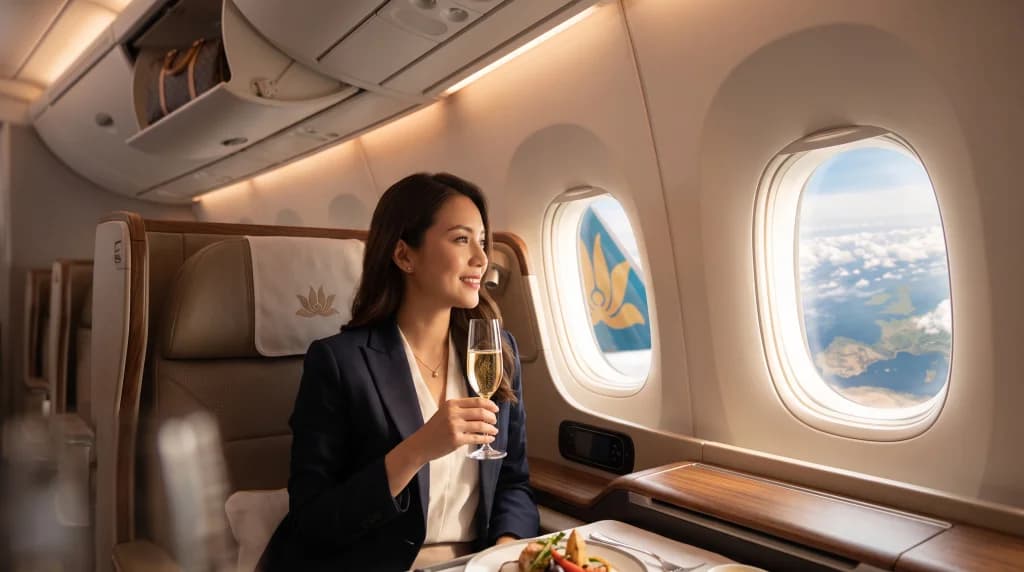
- Affordable Premium Cabin Access: For frequent flyers, the most compelling value lies in the premium cabins. For a fraction of the cost of an intercontinental ticket (often 150 to 250 euros rather than thousands), travelers can book a short-haul business class seat to enjoy an expansive fully flat bed (lie-flat seat), priority terminal access, airport lounge entry, and pre-departure champagne.
Notable European Fifth Freedom Corridors
Fifth Freedom routing through Europe evolves as new aircraft gain range and airlines adjust network strategies, but several routes remain firm fixtures for aviation enthusiasts and savvy travelers:
1. Milan-Malpensa (MXP) – Barcelona-El Prat (BCN) with Singapore Airlines
The premier European Fifth Freedom flight. Singapore Airlines deploys its flagship long-haul Airbus A350-900 on this short sector across the Mediterranean. In economy class, travelers experience Singapore Airlines' signature service, hot meal catering, and the extensive KrisWorld entertainment catalogue on a flight that lasts barely eighty minutes. In business class, passengers secure a full lie-flat bed in a 1-2-1 direct-aisle-access layout, while Premium Economy provides wide seating and enhanced service at a price point comparable to a standard legacy carrier's economy fare.
2. Athens (ATH) – Larnaca (LCA) with Gulf Air
A classic Eastern Mediterranean route that connects the Greek capital to Cyprus. Periodically operated by long-haul carriers from the Middle East and Asia, this sector allows passengers to bypass regional narrow-body aircraft in favor of wide-body jets (such as Boeing 787s), offering a noticeably quieter cabin altitude and superior air conditioning systems on a flight under two hours.
3. Madrid-Barajas (MAD) – Frankfurt (FRA) with LATAM
While LATAM is a South American carrier rather than an Asian airline, this long-standing trans-European tag flight deserves special mention. Flown using a Boeing 787-9 Dreamliner as the European extension of its transatlantic service from Santiago de Chile, it routinely prices out at competitive rates. Economy passengers benefit from the Dreamliner’s higher cabin humidity and electrochromic dimming windows, while business class travelers gain access to wide lie-flat seating across the heart of Western Europe.
4. Stockholm-Arlanda (ARN) – Oslo-Gardermoen (OSL) with Ethiopian Airlines
Another popular long-haul tag route in Northern Europe. Star Alliance member Ethiopian Airlines operates between the Swedish and Norwegian capitals using an Airbus A350-900 or Boeing 787 Dreamliner as an extension of its long-haul rotation from Addis Ababa. The airborne time is under an hour, yet passengers travel on an intercontinental wide-body aircraft—a marked contrast to the high-density regional jets that typically dominate Scandinavian domestic and regional routes.
Operational Challenges: Border Controls and Turnaround Windows
Executing Fifth Freedom flights requires complex coordination from airline operations and ground handlers. Operating a foreign-registered aircraft between two third-party hubs introduces distinct procedural constraints:
1. Border Controls and Schengen Area Logistics
Many Fifth Freedom routes operate between nations within the Schengen Area (such as Milan and Barcelona), yet the inbound aircraft originates in a non-Schengen third country. This creates logistical complexity on the ground:
- Transit passengers continuing from the primary departure point must remain separated from embarking local passengers or clear specific transit security screening.
- Locally originating Schengen passengers must be directed to designated gates to ensure they do not accidentally cross international border control points when boarding an international wide-body.
- Baggage handling requires strict segregation: local intra-European luggage is loaded into designated Unit Load Devices (ULDs) to prevent it from being misdirected to international customs carousels upon arrival.
2. Rapid In-Flight Service Delivery
Delivering meal and beverage service to several hundred passengers on an aircraft that spends barely 25 minutes at its cruising ceiling demands precise cabin management. Flight attendants execute streamlined service routines: trolleys enter the aisles within seconds of the seatbelt sign turning off, and business class meals are coordinated with rapid precision. For the crew, these short legs are among the most fast-paced intervals of their long-haul duty roster.
How to Find and Book Fifth Freedom Routes
Airlines rarely advertise these short-hop flights heavily in European consumer media; for an international mega-carrier, an intra-European tag-on flight represents a small slice of total route revenue. Travelers can locate and secure these flights using standard booking tools:
- Flight Search Engines: On platforms like Google Flights or Skyscanner, search intra-European city pairs and filter specifically for non-European carriers. If Singapore Airlines, LATAM, or Ethiopian Airlines appears on a route within the EU, it indicates a Fifth Freedom sector.
- Check the Aircraft Type: When comparing flight listings between cities like Milan and Barcelona, check the equipment column. An entry listing a Boeing 787, Boeing 777, or Airbus A350 immediately distinguishes the service from standard A320 and 737 operators.
- Book Directly with the Operating Carrier: Always purchase tickets directly through the operating carrier's website (e.g., singaporeair.com). This ensures direct access to seat selection maps and smoother rebooking should flight schedules change.
- Frequent Flyer Redemptions: Fifth Freedom flights offer exceptional value for airline alliance miles (such as Star Alliance points). Because award redemption charts are typically distance-based, a business class ticket on a short intra-European wide-body tag flight requires very few miles, with minimal associated passenger taxes.
Conclusion: An Elevated Way to Fly Short-Haul
Short-haul European flying does not have to mean accepting cramped seating, hidden baggage fees, and minimal amenities. Through the legal framework of the Fifth Freedom of the Air, a straightforward regional journey can be turned into an enjoyable flight experience.
Securing a seat on an international wide-body for an intra-European flight delivers generous legroom, complimentary checked baggage, and seatback entertainment on a short hop. It also provides a taste of long-haul hospitality and intercontinental equipment without the high ticket price or multi-hour time commitment. For travelers who enjoy aviation, it remains one of the best-value options in commercial air travel.