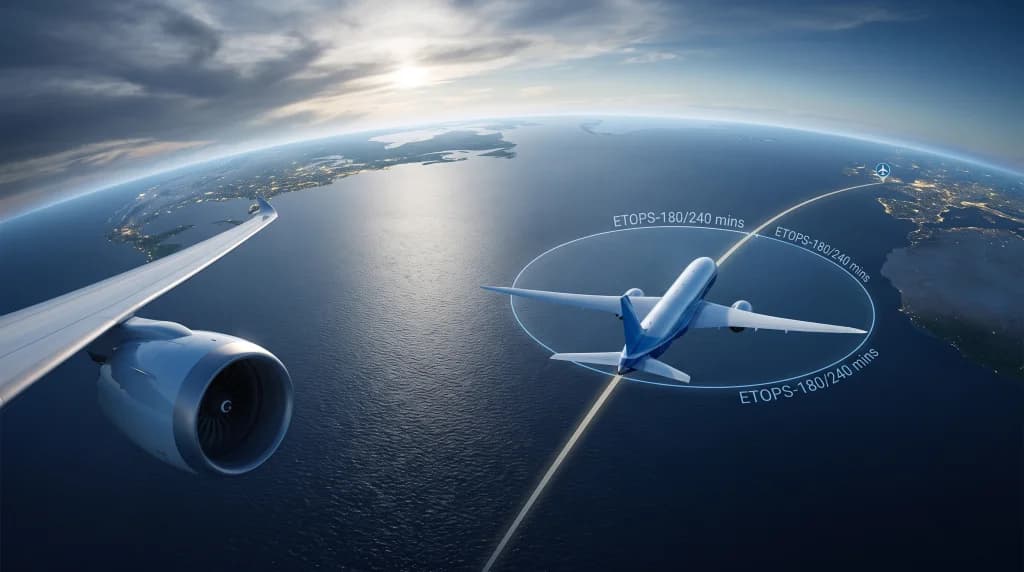
The ETOPS Rule and Oceanic Flights: What It Means in Practice
Introduction: The Revolution That Shrank the Blue Planet
Today, few travelers look twice at a twin-engine Boeing 787 Dreamliner, Airbus A350, or even a narrow-body Airbus A321LR cruising across the vast expanses of the North Atlantic, the Pacific, or the frozen wastes of the Arctic. Passengers sip coffee, stream movies on high-definition inflight entertainment displays, and nap, rarely contemplating the fact that several thousand kilometers of open, hostile ocean stretch beneath the wings—and that the nearest strip of dry land may be farther away than London is from Athens. For decades, however, undertaking such an oceanic transit aboard an aircraft with merely two engines was legally unthinkable and operationally prohibited.
Throughout the piston era and the dawn of commercial jet aviation, an iron rule governed the skies: only airframes with three or four engines were permitted to venture across major oceanic corridors. Long-haul flight was synonymous with heavy, multi-engine powerhouses: the iconic Boeing 747 Jumbo Jet, the McDonnell Douglas DC-10, and the Lockheed L-1011 TriStar. The conventional wisdom held that suffering an in-flight engine shutdown on a twin-engine aircraft over the middle of an ocean was a direct prelude to disaster. That consensus shattered in the mid-1980s with the introduction of a regulatory framework that fundamentally redefined airline economics and global route networks: ETOPS (Extended-range Twin-engine Operational Performance Standards). While the official acronym sounds bureaucratic and technical, flight crews and maintenance engineers quickly coined an irreverent, morbidly accurate definition of their own: Engines Turn Or Passengers Swim. What does an ETOPS certification actually entail, how did propulsion engineers eliminate common-mode failures, and what happens on the flight deck when a high-bypass turbofan fails thousands of miles from the nearest coastline?
The History of Caution: The 60-Minute Rule and the Four-Engine Paradigm
To grasp the scale of the ETOPS breakthrough, one must return to 1953. The United States Federal Aviation Administration (FAA), observing the alarming failure rates of early high-displacement radial piston engines—where powerplants such as the Pratt & Whitney R-4360 Wasp Major or the Wright R-3350 regularly suffered catastrophic cylinder failures, thrown rods, or engine fires—codified the strict 60-Minute Rule.
This mandate dictated that no two-engine commercial transport could be operated on an airway that routed the airframe farther than 60 minutes of flying time at single-engine cruise speed in still-air conditions from an adequate diversion aerodrome. In operational practice, this drew restricted buffer rings around every continental coastline, corresponding to roughly 300 to 400 nautical miles. Everything beyond those circles—the expanses of the world's oceans, uninhabited deserts, and polar zones—became restricted airspace for twins.
Airlines seeking to connect city pairs like London and New York, or Los Angeles and Honolulu, had no choice but to purchase, crew, and maintain expensive, fuel-thirsty three- and four-engine aircraft. Twin-engine jets were relegated to coastal hugging—staging cautiously via Greenland and Iceland. This extended flight distances, escalated fuel burn, and made non-hub transatlantic city pairings economically unfeasible for commercial carriers.
The Technological Leap: When the Turbofan Mastered Reliability
The 1970s and 1980s delivered profound advancements in metallurgy, thermodynamics, and computer-aided turbine manufacturing. The arrival of high-bypass turbofans—such as the General Electric CF6, the Pratt & Whitney JT9D, and the Rolls-Royce RB211—fundamentally altered powerplant reliability metrics. Instead of multiple mechanical failures per thousand flight hours, the rate of In-Flight Shut Downs (IFSD) dropped to fractions of a percent per thousand operating cycles.
The turning point arrived in 1985. The FAA approved the world's first ETOPS-120 operational framework, granting Trans World Airlines (TWA) permission to dispatch a twin-engine Boeing 767-200 from Boston to Paris, authorized to route up to 120 minutes away from adequate diversion airfields on a single engine. The aviation industry watched with acute skepticism, but the flight landed without a hitch. Over the ensuing decades, regulators methodically pushed diversion boundaries outward: ETOPS-180 (the global gold standard, unlocking 95% of the planet's surface), ETOPS-240, ETOPS-330, and ultimately the unprecedented ETOPS-370 rating granted to the Airbus A350—authorizing the widebody to operate over six hours away from the nearest usable runway on one engine.
The Anatomy of Certification: A Three-Pillar System
Passengers often assume that ETOPS is simply an operational badge affixed to the airframe on the assembly line. In reality, ETOPS is a rigorous, tripartite ecosystem comprising the aircraft airframe-engine pairing (Type Design Approval), carrier-specific maintenance engineering protocols (Maintenance), and specialized flight planning and crew training (Operational Approval).
1. Airframe System Redundancy
An aircraft built and certified for ETOPS operations differs significantly from an otherwise identical airframe intended strictly for overland domestic hops. If an engine flames out over mid-ocean, it eliminates not only 50% of total propulsive thrust, but also an entire primary electrical generator and an engine-driven hydraulic pump. Consequently, an ETOPS-rated airframe is equipped with a heavily fortified systems architecture:
- High-Altitude Auxiliary Power Unit (APU) Start: The onboard APU generator must demonstrate cold-soak starting reliability at maximum cruise altitudes (e.g., FL410 in ambient temperatures below -60°C) to immediately backfeed essential electrical buses in the event of an engine-driven generator loss.
- Ram Air Turbine (RAT): A deployable propeller concealed within the fuselage or wing fairing that automatically drops into the airstream during a total electrical or hydraulic failure, using dynamic air pressure to pressurize flight control hydraulics.
- Extended Cargo Hold Fire Suppression: On an ETOPS-180 flight, the cargo compartment fire-suppression systems must carry sufficient Halon extinguishing agent to knock down an active fire and maintain an inert cargo atmosphere for a minimum of 180 minutes, plus an additional 15-to-20-minute holding and approach buffer.
- Extended Passenger Oxygen Reserves: In the event of an uncontained cabin depressurization over oceanic terrain, the aircraft must descend to 10,000 feet (where ambient air is breathable, but fuel burn increases dramatically). Supplemental gaseous or chemical oxygen systems must sustain passengers and crew across the entire low-altitude diversion profile.
2. Maintenance Protocols: Eliminating Common-Mode Human Error
The historical archive of commercial aviation safety confirms that catastrophic multi-engine failures rarely stem from simultaneous, unlinked metal fatigue; they arise almost exclusively from human maintenance errors. To counteract this, ETOPS mandates strict segregation within maintenance, repair, and overhaul (MRO) facilities. The core principle is absolute: no single technician may perform maintenance on both engines during the same maintenance visit.
If a twin-engine aircraft undergoes oil filter replacements, borescope inspections of turbine stages, or fuel line maintenance, Technician A inspects the left engine under Inspector X, while Technician B independently works on the right engine under Inspector Y. This separation eliminates systemic common-cause failures: if a technician incorrectly torques an oil seal or forgets an O-ring on Engine 1, they cannot duplicate that fatal mistake on Engine 2. This single administrative rule has prevented numerous potential dual-engine flameouts.
The Dispatch Matrix: How Transoceanic Flights Are Routed
Long before an aircraft lifts off the runway, the airline's flight dispatch team compiles the Operational Flight Plan (OFP). In an ETOPS dispatch, oceanic airspace is partitioned into defensive corridors anchored to designated En-Route Alternate Airports (ETOPS Alternates).
A flight crew relies on specific operational criteria when reviewing oceanic routing:
- Adequate Airport: An aerodrome that meets the physical dimensions and capabilities required for the aircraft type: a runway of sufficient length, width, and pavement loading capacity (PCN), operational instrument approach aids (e.g., ILS), and required categories of Aerodrome Rescue and Firefighting (ARFF) services.
- Suitable Airport: An adequate airport that, during the anticipated time window of an emergency diversion, is forecast to maintain surface weather conditions (ceiling, crosswind component, and Runway Visual Range) strictly above elevated ETOPS dispatch weather minimums. These weather buffers are significantly more conservative than standard scheduled landing minimums.
- ETOPS Entry Point (EEP): The geographic coordinate along the route where the aircraft first exceeds the baseline 60-minute single-engine still-air diversion threshold from an adequate airfield. Passing the EEP transitions the crew into heightened monitoring protocols.
- ETOPS Exit Point (EXP): The coordinate where the aircraft re-enters continuous 60-minute coverage of land-based alternates.
- Equal Time Point (ETP / Critical Point): The exact mathematical point along the flight track between two designated ETOPS alternates (such as Keflavik in Iceland and Kangerlussuaq in Greenland) from which single-engine transit times to either diversion airfield are identical to the second, calculated using real-time forecast upper winds. Prior to crossing the ETP, a diversion turns back; once past the ETP, the crew diverts forward.
Emergency Scenario: Engine Failure over the Mid-Pacific
What happens on the flight deck when an aircraft is cruising at FL370 halfway between San Francisco and Honolulu, a master caution chime rings out, and the Engine-Indicating and Crew-Alerting System (EICAS) illuminates a crimson warning: ENG 1 FAIL?
There is no panic. Airline flight crews rehearse this exact failure in full-flight simulators on a recurring basis. The pilots adhere to the foundational aviation hierarchy: Aviate, Navigate, Communicate.
1. The Drift Down Procedure: The Physics of Altitude Loss
A modern widebody cruising at an operating gross weight of 220 tons cannot sustain level flight at 37,000 feet on a single engine. One turbofan cannot generate the thrust required to overcome aerodynamic drag in the thin air of upper flight levels. The crew executes a Drift Down:
- Maximum Continuous Thrust (CON) is set on the operating engine.
- The flying pilot applies generous rudder input to counteract the immense thrust asymmetry of a single high-output engine, trimming the rudder surface to center the slip-skid indicator.
- The autothrottle is disconnected or managed, and the flight guidance system is commanded to establish a target drift-down airspeed (such as Green Dot speed on an Airbus).
- The aircraft enters a gentle, stabilized descent of a few hundred feet per minute until settling at its One-Engine Inoperative (OEI) Ceiling—typically between FL180 and FL240 (roughly 5,500 to 7,300 meters), depending on aircraft weight. In this denser air, the single engine easily sustains stable, level cruise for thousands of miles.
2. The Offset Maneuver: Clearing the Oceanic Highway
Oceanic airspace lacks ground-based primary radar coverage. Aircraft navigate along strict, invisible corridors—such as the Organised Track System (OTS) over the North Atlantic or PACOTS over the Pacific—separated by precise temporal and vertical buffers. An aircraft drifting downward out of its assigned flight level constitutes an immediate hazard to traffic cruising on lower flight levels.
Standard operating procedures require an immediate turn away from the track centerline by 30, 45, or 90 degrees (dependent upon regional oceanic airspace rules) to acquire a Strategic Lateral Offset (SLOP) of 5 to 15 nautical miles clear of the track structure. Only after deviating clear of the traffic flow does the crew descend to their OEI ceiling, squawk transponder emergency code 7700, and broadcast a MAYDAY or PAN-PAN call on the international emergency guard frequency (121.500 MHz) and air-to-air interplane frequencies.
3. Diverting to the Suitable Field
The Flight Management System (FMS) tracks distance and fuel to the active ETP. If the failure occurred five minutes before the calculated Equal Time Point, the crew turns back toward their departure alternate; if five minutes past, they press on to the forward alternate. Flying on one engine, the crew may face a transit of 180, 240, or 330 minutes to touchdown. Dispatch fuel reserves are planned to cover the increased aerodynamic drag of continuous rudder deflection, lower cruise altitudes, and the bleed-air penalties associated with engine and wing anti-ice operation in icing conditions.
From ETOPS to EDTO: The Decline of the Four-Engine Jet
The operational safety record compiled under ETOPS was so high that the International Civil Aviation Organization (ICAO) updated the framework to EDTO (Extended Diversion Time Operations). This expanded approach applies the same systems scrutiny to all commercial air transports regardless of powerplant count. Even modern tri-jets and quad-jets must demonstrate certified cargo fire suppression duration and oxygen capacity when operating long distances from landing sites.
Ultimately, ETOPS sealed the fate of four-engine commercial airliners. Operating four engines requires roughly twice the maintenance overhead, burns significantly more fuel, and incurs heavy weight penalties. Once modern twin-engine aircraft proved capable of safely crossing any ocean on Earth with unmatched dispatch reliability, icons like the Boeing 747 and Airbus A380 became economically obsolete for mainstream passenger routes. The quad-jet era drew to a close not for lack of passenger admiration, but through the efficiency and reliability of ETOPS engineering.
Conclusion: Engineering Triumphs over the Elements
The next time you gaze through the cabin window at the deep blue swell of an ocean while listening to the calm voice of the captain giving a route update from the middle of the Atlantic, remember the moniker: Engines Turn Or Passengers Swim.
Beneath that bit of flight deck gallows humor sits one of the most comprehensive safety frameworks in modern engineering. It represents an operating discipline where internal engine components undergo meticulous non-destructive testing, critical systems feature triple redundancy, maintenance technicians adhere to independent workflows, and flight crews train extensively for every contingency. Thanks to ETOPS, oceans are no longer impassable barriers for twin-engine airliners—they are predictable, well-managed flight corridors traversed with precision every day.