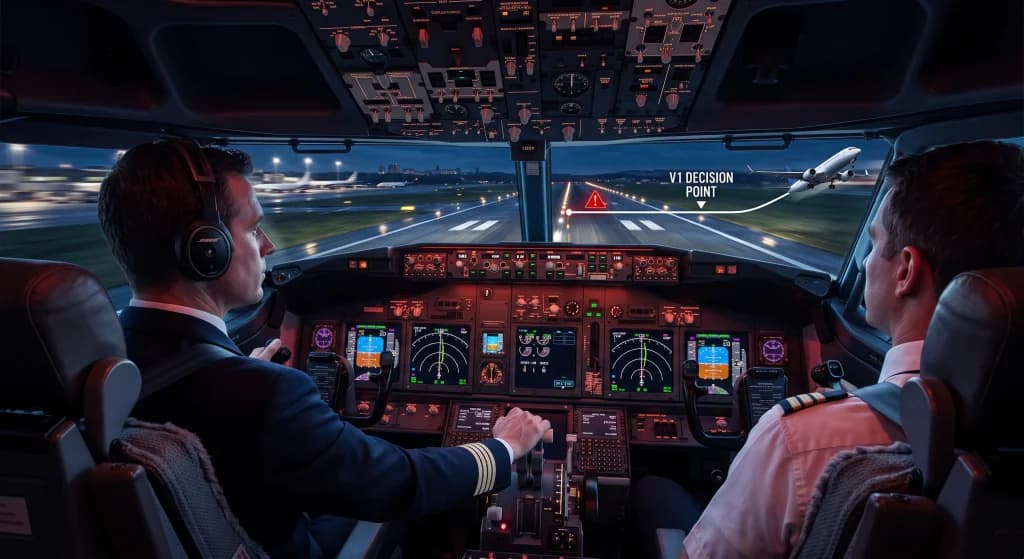
Split-Second Decisions (V1 and Go-Around): Why Aborted Landings Are Routine
Introduction
From the perspective of a passenger seated in row 18, few in-flight events feel more startling or anxiety-inducing than a sudden change in aircraft dynamics moments before touchdown. The airliner is floating mere tens of meters above the runway, hangars and approach lighting systems are flashing past the windows, the tires are primed to kiss the tarmac—and suddenly, in a fraction of a second, the quiet cabin is shattered by the deafening roar of turbofan engines spooling to maximum thrust. Powerful g-forces pin passengers into their seats, the nose pitches steeply skyward, and the ground falls away rapidly below. Conversations stop, and a pale panic grips the cabin: "We were inches from a disaster!"
For an airline flight crew, that exact moment carries zero drama. It is a textbook, routine, and rigorously practiced standard operating procedure: the Go-Around (Missed Approach). A similar dynamic governs the opposite end of a flight profile—the takeoff roll along the active runway, where the line between aborting a departure and committing to the air hinges on a single calculated velocity figure: the decision speed, V1. In popular culture and passenger imagination, both maneuvers are frequently misconstrued as near-miss emergencies. In reality, they represent the highest achievement of modern aviation safety culture: an institutionalized triumph of proactive risk mitigation over bravado. Let us demystify these procedures and understand why that sudden roar of the engines is definitive proof that your flight is in the hands of consummate professionals.
Takeoff Anatomy: The Sacred Trinity of V1, VR, and V2
Before an airliner advances its throttles on the runway centerline, the onboard Flight Management Computers (FMC/FMS) process intricate aerodynamic and thermodynamic calculations. Line pilots never launch on guesswork. By analyzing gross takeoff weight, outside air temperature, barometric pressure (QNH), runway slope, surface contamination (standing water, snow, slush), and current airframe technical status, the crew establishes three fundamental performance speeds.
1. V1 Speed (Takeoff Decision Speed): The Point of No Return
V1 is the critical speed at which the decision to reject or continue the takeoff must be executed. It is the single most vital operational threshold during the departure phase, establishing an absolute physical line in the sand. Prior to reaching V1, safety priority belongs entirely to staying on the ground: should an uncontained engine fire erupt, a tire burst, the flight computers flag a flight control degradation, or a vehicle or wildlife breach the active runway, the captain aborts without hesitation via a Rejected Takeoff (RTO), deploying maximum carbon braking, ground spoilers, and full reverse thrust.
The instant the landing gear wheels cross the calculated V1 speed, however, the operating paradigm reverses. Past V1, the takeoff MUST continue regardless of what failure occurs. Even if a catastrophic engine failure occurs at V1 + 1 knot accompanied by a loud report and severe airframe vibration, the captain removes their hand from the thrust levers and transfers it to the flight controls. The laws of runway physics dictate that the remaining pavement is insufficient to arrest the kinetic energy of the accelerated aircraft safely. Attempting to abort past V1 risks a high-speed Runway Excursion, carrying a high risk of airframe destruction and injury. Transport-category airliners are engineered and certified to safely climb away on a single operational engine.
2. VR (Rotation Speed) and V2 (Takeoff Safety Speed)
Moments after V1 comes VR (Rotation Speed)—the precise threshold where the flying pilot applies smooth, steady back-pressure on the control column or sidestick, rotating the aircraft pitch at approximately 3 degrees per second to achieve the critical wing angle of attack required for liftoff. Shortly thereafter, the aircraft achieves V2 (Takeoff Safety Speed)—the target climb velocity ensuring that, even with an engine inoperative, the aircraft maintains the legally mandated minimum climb gradient necessary to clear terrain and obstacles surrounding the airfield.
RTO (Rejected Takeoff): A Brutal Kinetic Test of Braking Systems
Aborting a takeoff roll below V1 sounds conceptually straightforward, yet it subjects the airframe to extreme mechanical stress. Consider a fully loaded Boeing 777-300ER weighing 250 metric tons, accelerating past 260 km/h (140 knots), brought to an abrupt, complete halt within a dozen seconds.
An RTO event executes with clinical automated precision:
- Crew Action: The captain snaps the thrust levers to ground idle and pulls the reverse thrust levers to their mechanical limits.
- Autobrake RTO: The automated braking system detects throttle closure at ground speeds exceeding 85–90 knots and instantly meters full hydraulic operating pressure (up to 3,000 PSI) into the multi-disc carbon brake packs housed within the main landing gear bogeys. Deceleration forces exceed those of any standard landing.
- Ground Spoilers (Speedbrakes): Large composite flight spoiler panels deploy along the upper wing surfaces within milliseconds, destroying remaining aerodynamic lift to dump aircraft weight directly onto the wheels, maximizing tire traction against the concrete.
- Landing Gear Thermal Dynamics: Kinetic friction drives brake temperatures to incandescent levels between 700°C and 1,000°C, glowing bright orange. Wheel rims feature calibrated thermal fusible plugs that melt under design heat loads, releasing pressurized nitrogen from the tires safely to prevent explosive overpressure blowouts.
The Go-Around: Reframing the Landing as a Conditional Exercise
To appreciate why a go-around is standard operational practice rather than an emergency, one must reframe how airline crews approach the landing phase. Professional flight training instills an uncompromising philosophy: every instrument approach is assumed to be a go-around by default; touchdown occurs ONLY if 100% of defined safety criteria are verified.
Commercial pilots do not land at any cost. Until the main gear tires make positive ground contact and thrust reversers deploy, the aircraft exists in an active state of readiness to return to the safety of the sky. The open atmosphere is an aircraft's natural operational environment; the ground represents a solid obstacle to which the airframe commits under strictly defined conditions.
The Stabilized Approach Concept: A Non-Negotiable Gate
The primary trigger behind flight crew decisions to initiate a go-around is failing to satisfy the mandatory criteria of a Stabilized Approach. Regulated globally by ICAO, civil aviation authorities, and airline flight operations manuals, these parameters must be satisfied by a specific vertical window—typically 1,000 feet Above Ground Level (AGL) in Instrument Meteorological Conditions (IMC) or 500 feet AGL in clear Visual Meteorological Conditions (VMC).
An approach is officially classified as unstabilized—mandating an immediate go-around—if any single criterion breaches tolerance at the stabilization gate:
- Glide Path Tracking: The aircraft is excessively high or low relative to the precision ILS, GLS, or RNAV vertical path.
- Airspeed Tolerances: Indicated airspeed deviates outside the calibrated profile window, generally defined as -0 knots to +10 knots relative to calculated approach reference speed (VAPP). Excess speed risks runway overruns; deficient speed risks aerodynamic stall.
- Landing Configuration: The landing gear is not down and locked, or trailing-edge flaps and leading-edge slats are not set to the briefed landing position.
- Engine Thrust Spool-Up: Turbofans must not sit at flight idle. Engines must be stabilized at an active intermediate thrust setting, eliminating spool-up lag should an immediate climb be commanded.
- Rate of Descent (Vertical Speed): Descent rates must not exceed 1,000 feet per minute unless specifically briefed for specialized steep-approach procedures.
If an aircraft crosses the 1,000-foot gate carrying 15 knots of excess speed or a sudden wind shear shifts the aircraft off the runway centerline, the crew is prohibited from improvised flight control inputs to force a landing. The mandatory, standardized crew callout is immediate: "Unstable, Go-Around!".
Why Air Traffic Control or Flight Crews Abort Landings: Common Triggers
Cabin passengers experiencing a go-around often assume the aircraft suffered a technical failure. Statistical operational data confirms that the overwhelming majority of go-around events are prompted by external operational factors unrelated to aircraft airworthiness.
1. Occupied Runway / Runway Incursion
This is the most common reason for a tower-commanded abort: "Oscar Mike 123, go around, runway occupied!". A preceding landing aircraft may have rolled out slowly or missed its high-speed taxiway exit; a departing aircraft may have been delayed crossing the hold short line; or airport ground vehicles may be completing a runway foreign object debris (FOD) inspection. Safe aircraft separation is absolute—ATC will never clear a landing over an occupied surface.
2. Windshear and Meteorological Deterioration
Sudden crosswind gusts exceeding the certified crosswind demonstration limits of the airframe, low-level windshear alerts, or localized visibility dropping below system minimums due to sudden fog, snow squalls, or heavy rain showers frequently force missed approaches. If visual reference to runway markings or approach lighting is not acquired by the designated Decision Altitude/Height (DA/H), climbing away is the only lawful course of action.
3. Wake Turbulence Encounters
When trailing a heavy wide-body transport (such as an Airbus A380 or Boeing 777), strong wingtip vortex cores drift across the final approach path. If quartering crosswinds push wake turbulence into the path of a trailing narrow-body (like an A320), the crew may discontinue the approach to preserve controllability and avoid severe rolling moments.
Flight Deck Choreography: Behind the Scenes of a Go-Around
When the call to abort a landing occurs, a tightly choreographed sequence unfolds in the cockpit. There is no room for hesitation, confusion, or elevated voices. Flight deck tasks split strictly along certified divisions of labor: Pilot Flying (PF) and Pilot Monitoring (PM).
The standard operational anatomy of the maneuver proceeds as follows:
- Command and Thrust Application: The Pilot Flying depresses the throttle TO/GA (Takeoff/Go-Around) switches and calls aloud: "Go-Around, Flaps 15!" (or the designated aircraft flap target). The autothrottles command immediate climb power as the engines spool up.
- Pitch Rotation: The PF smoothly pitches the nose up toward the flight director command bars, establishing the positive climb attitude indicated by the Flight Management Guidance System. Autopilot modes automatically switch to the published Missed Approach lateral navigation profile.
- Initial Flap Retraction: The Pilot Monitoring immediately selects the commanded flap notch, reducing aerodynamic parasite drag while preserving optimal low-speed wing lift.
- Positive Rate and Gear Retraction: The PM cross-checks the altimeter tape and vertical speed indicator. Upon confirming climbing performance, the PM announces: "Positive Rate!". The PF immediately responds: "Gear Up!", and the PM raises the landing gear handle.
- ATC Coordination: Only after the flight path, clean airspeed, and vertical modes are secured does the flight crew notify air traffic control: "Tower, LOT 456, going around". The tower controller issues missed approach climb altitudes and radar vectors into the terminal area sequence.
Passenger Physiology: Why Does the Maneuver Feel So Violent?
If a missed approach is a safe, planned maneuver, why does it trigger visceral panic and an adrenaline rush inside the cabin? The answer lies in Somatogravic Illusions and the sensory limits of the human vestibular system in enclosed spaces.
During an approach to landing, the aircraft engines operate at low thrust settings, descending quietly through the air. Passengers mentally anticipate the journey's end and the familiar sound of tires touching pavement. When the engines surge into full TOGA thrust, the sudden forward linear acceleration stimulates the otolith organs inside the inner ear. Without a clear outside visual horizon to anchor spatial awareness, the human brain cannot distinguish linear acceleration from an extreme vertical pitch-up.
As a result, a passenger's spatial orientation interprets forward acceleration as a near-vertical climb or an out-of-control zoom climb into the sky. Compounded by the sound of flap drive actuators, the thud of the landing gear cycling into its wheel wells, and high-velocity wind noise over the airframe, this sensory disconnect induces acute stress in passengers unfamiliar with flight physics.
Just Culture: The Safety Philosophy That Eradicated "Get-There-Itis"
For decades throughout earlier eras of commercial aviation, a dangerous psychological trap persisted: Get-There-Itis—an unwritten pressure felt by flight crews to force an aircraft onto the ground on the first attempt to avoid flight delays, additional fuel burn, or scrutiny from airline management. Modern Safety Management Systems (SMS) and the industry-wide adoption of Just Culture completely dismantled that hazardous mindset.
In modern professional airlines, no pilot is penalized, questioned, or disciplined for executing a go-around. Conversely, failing to initiate a go-around from an unstabilized approach triggers mandatory safety reviews, flight data monitoring (FDM) flags, and remedial simulator training. Burning an additional 500 to 800 kilograms of jet fuel and accepting a 15-minute holding delay represents an airline's most cost-effective and valuable safety investment.
Conclusion: Relax and Trust the Professionals
Commercial air travel remains a model of industrial reliability because absolute operational control rests in the hands of two extensively trained professionals operating behind reinforced cockpit doors. An abort executed at V1 on the runway, or a go-around initiated fifty feet above the asphalt, is not a sign of failure—it is demonstrable proof that the redundant safety architectures of commercial aviation function with surgical precision.
The next time you are pushed firmly into your seat by climbing engines and watch the runway recede beneath you, resist the urge to grip the armrests in fear. Take a steady breath and recognize the consummate professionalism of a flight crew that decisively chose your safety over convenience. The aircraft will climb to a safe holding altitude, re-enter the arrival pattern, and settle onto the runway a short time later. In commercial aviation, a few minutes of patience remains the easiest price to pay for an absolute guarantee of arriving safely.