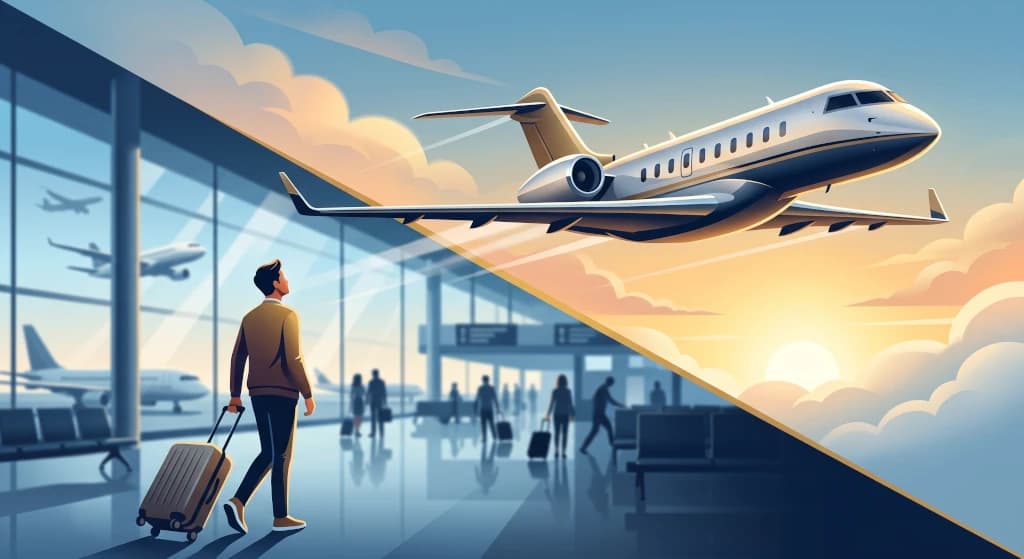
Empty Legs: Flying on a Private Jet for the Price of an Economy Ticket
Introduction
For the vast majority of passengers, business aviation conjures images of an exclusive, hermetic realm reserved for billionaires, touring rock icons, and corporate executives. Crystal champagne flutes served at 45,000 feet, dedicated private VIP terminals that bypass chaotic queues, and chauffeured vehicles pulling right up to the airstairs of a gleaming Bombardier or Gulfstream seem financially out of reach. Chartering such an aircraft via conventional on-demand charter typically demands tens of thousands of euros for a mere two-hour hop across Europe.
Yet hidden within the operational mechanics of executive aviation lies a fascinating market inefficiency widely considered the best-kept secret of affordable luxury: Empty Legs, also known as deadhead repositioning flights. This operational reality enables aviation enthusiasts and savvy travelers to settle into the leather cabins of a Cessna Citation, Pilatus PC-24, or Embraer Phenom at a fraction of their standard charter rates—frequently rivaling the price of a flexible commercial economy or business class ticket. To capitalize on these high-altitude bargains, however, one must master the underlying logistics of private jet fleets, their non-negotiable operational constraints, and the inherent risks that make this form of travel a discipline reserved for the nimble.
The Anatomy of an Empty Leg: Where Do Repositioning Flights Come From?
To grasp how empty legs originate, one must recognize the fundamental divergence between commercial scheduled aviation and private business aviation (Part 135 / Part NCC operations). Network carriers like Lufthansa or British Airways run on tightly calibrated cyclical rotations—an aircraft operating from Warsaw to Paris turns around almost immediately to fly paying passengers back to Warsaw.
In the private jet sector, this scheduled symmetry collapses. Ultra-high-net-worth clients commission aircraft for bespoke, point-to-point, one-way missions:
- The One-Way Charter: A charter customer books a flight from London Luton to Nice for the weekend, refusing to pay the steep aircraft parking and standby fees required to keep the jet and crew idling on the French Riviera.
- The Need to Reposition (Ferry Flights): The aircraft operator has another confirmed passenger departing Geneva in two days, or must return the airframe to its maintenance base in Munich for a mandatory phase inspection.
- Flying Empty: The jet must fly from Nice to Geneva or Munich completely empty. The flight crew is on duty, the turbine engines burn Jet A-1 fuel, and the operator incurs Eurocontrol en-route air navigation charges and airport landing slots.
For the aircraft management company, every ferry sector is a pure operational loss. Estimates indicate that 30% to 40% of all private jet sectors worldwide are flown without a single passenger aboard. To offset fuel burn, crew per diems, and airport fees, operators offload these repositioning legs at steep discounts ranging from 50% to as much as 75–80% off standard retail charter rates.
Empty Leg Economics: Deconstructing the Cost Equation
Demystifying empty leg pricing requires breaking a core commercial aviation assumption: in private aviation, you do not book an individual seat—you charter the entire aircraft hull (though shared crowd-chartering models are slowly emerging). The practical takeaway is straightforward: the fixed cost of the flight is divided among everyone you welcome into the cabin.
Consider a realistic European routing scenario:
- Route: Zurich (ZRH) to Nice (NCE), flight time: approximately 55 minutes.
- Aircraft: Light business jet, such as a Cessna Citation CJ2+ or Embraer Phenom 300, accommodating 6 passengers.
- Standard On-Demand Charter Rate: Approximately €6,500 – €8,000.
- Empty Leg Deal Price: Approximately €1,800 – €2,400 for the entire aircraft.
- Per-Passenger Calculation: Assembling a party of 6 aviation enthusiasts drives the per-seat cost down to €300 – €400 per person.
At this price point, a passenger on a legacy commercial carrier often receives a standard economy seat with a carry-on allowance. On an empty leg, that same expenditure buys a private jet experience: bypassing the main terminal, checking in through an exclusive Fixed Base Operator (FBO) lounge, and being airborne within 15 minutes of arriving at the airfield.
Private Jet Categories Available on Empty Legs
The aircraft inventory found across repositioning marketplaces is vast, ranging from efficient single-engine turboprops to long-range intercontinental flagships.
1. Turboprops and Very Light Jets (VLJ)
This entry-level category includes workhorses like the Pilatus PC-12, Cessna Citation Mustang, and Eclipse 550. Typically seating 4 to 6 passengers with ranges of 1,500 to 2,500 km, these airframes yield the most accessible price tags in empty leg feeds. Short regional sectors (e.g., Berlin to Vienna or Zurich to Milan) frequently post for €1,200 to €1,600 total—a price floor that outcompetes high-speed rail and commercial business class when filled to capacity.
2. Midsize and Super-Midsize Jets
Featuring platforms such as the Hawker 800XP, Bombardier Challenger 300/350, and Cessna Citation Latitude, this segment introduces true stand-up cabins, fully enclosed aft lavatories, dedicated mini-galleys, and transcontinental ranges exceeding 5,000 km. Empty legs in this bracket allow groups of 8 to 9 travelers to cross continents (e.g., London to Athens) in quiet comfort at a fraction of legacy airline business fares.
3. Heavy Jets and Ultra-Long-Range Flagships
The pinnacle of executive travel: the Gulfstream G650, Bombardier Global 6000/7500, and Dassault Falcon 7X/8X. These cabins seat 12 to 16 passengers across multiple zones, including private staterooms, full-service galleys staffed by a flight attendant, and lie-flat divans. Transatlantic or intercontinental repositioning sectors (e.g., New York to London or Dubai to Paris) can still cost €10,000 to €20,000—a substantial sum, yet competitive on a per-seat basis against full-fare commercial First Class.
The Passenger Experience: Navigating the FBO Terminal
Flying on an empty leg affords the exact same streamlined, premium ground and in-flight experience enjoyed by full-fare private charter clients.
The journey unfolds through distinct touchpoints:
- Fixed Base Operator (FBO) Facilities: The journey bypasses the main airline terminal completely. Passengers arrive at an executive aviation facility (such as Signature Flight Support or Jet Aviation), featuring quiet lounges, concierge service, and complimentary refreshments.
- Expedited Customs and Security Screening: Security checkpoints and passport control are handled discreetly on site, typically taking less than two minutes. Arriving at the terminal 20 to 30 minutes before wheels-up is standard protocol.
- Exemption from Strict Liquid Bans: Executive aviation is free from the standard 100 ml carry-on liquid limits. Full-sized toiletries, luxury perfumes, and personal bottles of wine can be carried directly into the cabin.
- Cabin Amenities: Even on discounted repositioning legs, passengers are welcomed with complimentary champagne, catering platters, fresh fruit, and an open bar.
The Pitfalls and Structural Risks of Empty Legs
If empty legs offered unconditional luxury without compromises, scheduled airlines would struggle to sell premium tickets. The reality is unyielding: an empty leg is an asymmetric, secondary product where the passenger remains entirely dependent on the primary charter client.
1. High Cancellation Risk
This is the central hazard of the model. An empty leg exists solely because another customer funded the primary leg. If that lead client cancels their trip, delays their departure by 24 hours, or diverts their arrival from Nice to Cannes, your empty leg vanishes instantly. The operator will issue a full refund, but carries zero legal obligation to rebook you on a commercial carrier, arrange hotel accommodations, or pay passenger rights compensation.
2. Rigid Departure Schedules
Empty leg passengers do not control departure times. Flight schedules are dictated by the aircraft's onward charter commitment or maintenance slot. If the repositioning flight plan requires a 07:15 departure, you must comply. Furthermore, air traffic control slot revisions or delays from the primary charter can shift departure times at the eleventh hour.
3. The One-Way Dilemma
Empty legs are almost never sold as round-trips. You are purchasing a one-way flight from point A to point B. Securing return transport is entirely your responsibility, and booking a last-minute one-way commercial flight home can quickly erode any savings achieved on the private jet segment.
4. Extremely Compressed Booking Windows
The most heavily discounted empty legs appear on booking radars 24 to 48 hours before scheduled departure. Taking advantage requires complete schedule flexibility, packed luggage, and the readiness to head to the airfield on short notice.
Where and How to Source Empty Legs: Digital Aggregators and Brokers
The era when empty legs were traded exclusively through private telephone networks between well-connected charter brokers has given way to digital distribution channels.
Key avenues for finding empty legs:
- Specialized Aggregator Apps: Mobile platforms like Victor, PrivateFly, LunaJets, and GlobeAir feature dedicated marketplace sections displaying live repositioning sectors with search filters for aircraft class and city pairs.
- Direct Fleet Operator Subscriptions: Signing up for newsletters and push notifications from dedicated fleet operators provides early access to inventory. Operators like GlobeAir (commanding a unified fleet of Citation Mustangs in Europe) or VistaJet/XO publish daily empty leg opportunities directly.
- Retaining an Independent Charter Broker: Seasoned charter brokers maintain direct access to wholesale business aviation systems like Avinode (the industry's central B2B booking clearinghouse). By flagging your target route and time window, a broker can often negotiate a ferry sector before it hits public consumer apps.
The Tactical Playbook: Securing Your First Flight Safely
To ensure your debut private jet experience remains enjoyable rather than stressful, adhere to the core rules of experienced deal hunters:
Strategic rules for booking empty legs:
- Always Maintain a Backup Plan: Never rely on an empty leg for a high-stakes, time-critical event such as a wedding, business closing, or cruise departure. Reserve empty legs for spontaneous leisure trips where a last-minute cancellation means simply returning home or booking a commercial flight.
- Assemble a Pre-Vetted Travel Group: Trying to round up five friends who can drop everything and fly to southern Europe tomorrow morning on 30 minutes' notice is rarely successful. Maintain an active group chat with remote-working friends who are pre-committed to splitting a flight when an exceptional deal appears.
- Clarify Hidden Fees and Inclusions: Always confirm whether the quoted charter price is fully inclusive. Inquire about passenger handling fees, local airport passenger taxes, potential winter de-icing surcharges (which can run €1,000 to €3,000 if required), and specialized in-flight catering requests.
Conclusion: Calculated Spontaneity in the Skies
Empty legs represent a unique intersection of luxury and volatility. They demand logistical flexibility, a tolerance for uncertainty, and the agility to pack on a moment's notice. For those able to navigate these variables, the reward is an unmatched travel experience. For roughly the cost of a standard commercial airline ticket, travelers can bypass the friction of mass transit hubs and enjoy the effortless efficiency of private aviation.
For any aviation enthusiast, the chance to step aboard a private jet, observe flight operations from right behind the cockpit curtain, and climb straight to Flight Level 450 far above commercial traffic is an unforgettable experience. Empty legs prove that executive aviation is not entirely out of reach—provided you understand the operational mechanics and know how to seize the opportunity before the aircraft departs.