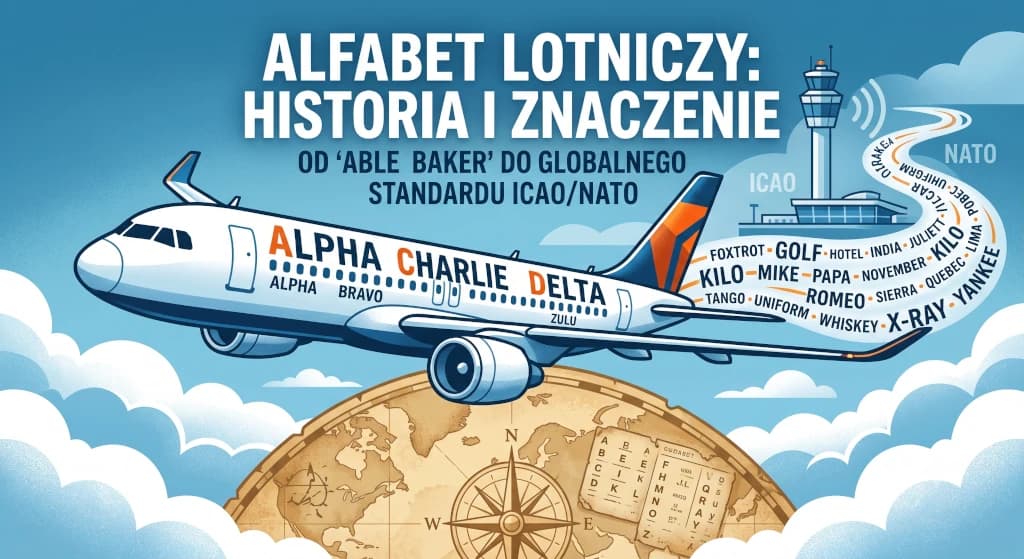
Aviation Alphabet (ICAO/NATO): History, Meaning, and Full Pronunciation Table
Introduction
Connecting with the air traffic control tower, changing frequencies, and shortly after, a rapid, almost monotonous series of words comes through the cockpit speaker: “Alpha-Bravo-Charlie, Cleared for take-off, runway two-seven, wind two-four-zero at ten knots”. To a layperson, this sounds like secret codes or incomprehensible movie jargon. For a pilot, an air traffic controller, and every aviation professional, however, it is the bedrock of safety.
We are talking about the ICAO International Phonetic Alphabet (often referred to simply as the aviation alphabet or the NATO alphabet). Although it consists of simple everyday words like Alfa, Foxtrot, or Sierra, its creation was the result of decades of experience, linguistic testing, tragic errors, and the continuous evolution of radio technology.
From Noisy Radio Waves to the Shared Language of the Skies
To understand why the aviation phonetic alphabet was created, we must step back to the dawn of radio communication. In the early years of aviation development, the primary tool for transmitting information was the telegraph and Morse code. As radiotelephony evolved, enabling the transmission of voice over long distances, a whole new problem emerged: signal quality.
Early radio stations were susceptible to atmospheric interference, static noise, crackling, and overlapping frequency waves. In addition, international aviation brought together people speaking different languages with varying accents and dialects. Under these conditions, transmitting a simple letter like “B” or “D” was a massive challenge. Through radio static, these sounds are nearly indistinguishable. A mistake in reading a single letter in an aircraft's callsign or runway coordinates could lead to a catastrophe.
The solution was to replace individual letters with full words, assigning a unique codeword to every letter of the alphabet.
Alphabet Evolution: From “Able Baker” to the ICAO Standard
Before the world agreed on a single global standard, phonetic chaos prevailed in the skies. Different countries, airlines, and military forces used their own tables of words.
1. The First International Alphabet (CCIR, 1927)
The first official international alphabet was approved by the International Telecommunication Union (ITU). It contained names of cities and well-known concepts (e.g., Amsterdam, Baltimore, Casablanca, Gallipoli). While it was a step in the right direction, many of these words were difficult to pronounce for non-English or non-Romance language speakers.
2. The "Able Baker" Military Standard (World War II)
During World War II, the US and UK armed forces used an alphabet known as the Joint Army/Navy Phonetic Alphabet, commonly referred to as the Able Baker alphabet (from its first letters: Able, Baker, Charlie, Dog). This system worked effectively in the English-speaking sphere, but proved inadequate with the post-1945 explosion of commercial civil aviation.
The word set used was as follows: Able, Baker, Charlie, Dog, Easy, Fox, George, How, Item, Jig, King, Love, Mike, Nan, Oboe, Peter, Queen, Roger, Sugar, Tare, Uncle, Victor, William, Xray, Yoke, Zebra.
3. The Birth of the ICAO Alphabet (1951–1956)
Following the establishment of the International Civil Aviation Organization (ICAO) in 1947, work began on creating a single, universal alphabet. Scientific research was commissioned to Professor Jean-Paul Vinay at the University of Montreal.
The key criteria required that the words:
- Be easily recognizable and understandable to native speakers of English, French, and Spanish.
- Possess a distinct rhythmic and phonetic structure.
- Not be easily confused with one another, even under conditions of severe radio static.
In 1951, ICAO presented its first version, but faced resistance from pilots who deemed some words unnatural. After further testing, the final modified version was introduced on February 1, 1956. Shortly thereafter, it was adopted by NATO and the International Telecommunication Union (ITU), becoming the global standard under the name International Radiotelephony Spelling Alphabet.
Official ICAO/NATO Table – Letters and Pronunciation
Here is the full set of words constituting today's aviation alphabet. Pay attention to the specific accented pronunciation—correct syllabification is crucial during radio transmissions.
- A – Alpha (AL-fah)
- B – Bravo (BRAH-voh)
- C – Charlie (CHAR-lee)
- D – Delta (DELL-tah)
- E – Echo (ECK-oh)
- F – Foxtrot (FOKS-trot)
- G – Golf (GOLF)
- H – Hotel (HOH-tell)
- I – India (IN-dee-ah)
- J – Juliett (JEW-lee-ETT)
- K – Kilo (KEY-loh)
- L – Lima (LEE-mah)
- M – Mike (MIKE)
- N – November (NO-vem-ber)
- O – Oscar (OSS-cah)
- P – Papa (PAH-PAH)
- Q – Quebec (keh-BECK)
- R – Romeo (ROW-me-oh)
- S – Sierra (see-AIR-rah)
- T – Tango (TANG-go)
- U – Uniform (YOU-nee-form)
- V – Victor (VIK-tah)
- W – Whiskey (WISS-key)
- X – X-ray (ECKS-ray)
- Y – Yankee (YANG-key)
- Z – Zulu (ZOO-loo)
Linguistic Curiosities and Spelling
It is worth noting that the international spelling features two specific deviations from standard English orthography:
- Alpha is sometimes spelled as Alfa – to avoid mispronunciation in countries where the combination “ph” is not pronounced as “f”.
- Juliett ends with a double “tt” – so French speakers do not treat the final “t” as silent, preventing incorrect pronunciations like “Zhulie”.
More Than Just Letters: How to Pronounce Digits in Aviation
Precise numerical communication is just as vital as spelling letters. A mistake in transmitting altitude (e.g., 3,000 feet instead of 8,000 feet) can have catastrophic consequences. Therefore, ICAO established a standardized English pronunciation for numbers:
- 0 – ZEERO
- 1 – WUN
- 2 – TOO
- 3 – TREE (the "th" sound is intentionally omitted, as it is difficult for non-native English speakers)
- 4 – FOW-er (pronounced with two syllables for extra clarity)
- 5 – FIFE (used instead of "five" to avoid confusion with the word "fire")
- 6 – SIX
- 7 – SEV-en
- 8 – AIT
- 9 – NINER (adding the ending prevents confusion with the German word "nein", meaning "no")
Multi-digit numbers are always transmitted by pronouncing each digit individually. For instance, an altitude of 10,000 feet is not spoken as "ten thousand", but as “WUN ZEERO ZEERO ZEERO ZEERO” or standardized as “WUN ZEERO THOUSAND”.
Why Is the Phonetic Alphabet Essential for Safety?
Communication in aviation relies on the principle of Loop Communication. A controller issues an instruction, and the pilot is obligated to repeat it back (readback). When the pilot uses the phonetic alphabet, the controller can instantly catch and correct any error.
A Real-Life Example:
When a pilot reports their callsign SP-ABC, they do not say "Sierra Papa A B C" over the radio. Hearing "A B C", a controller could misinterpret the individual letters. The correct phraseology is: “Sierra-Papa-Alpha-Bravo-Charlie”.
This eliminates the risk of:
- Words being distorted by cockpit noise or turbulence.
- Rapid speaking speed ruining message clarity.
- A pilot's accent causing confusion for the controller.
Applications Beyond Aviation
While the alphabet is widely associated with aviation and the military, its reliability has carried it into many other fields of life:
- Emergency Services (Police, Fire Department, Medical Rescue): Used to spell vehicle registration plates, surnames, or addresses during radio calls.
- Amateur Radio (HAM Radio): Radio enthusiasts worldwide use it to exchange callsigns under very weak signal conditions.
- Finance and IT Sectors: Customer service and technical support personnel use it to accurately dictate passwords, transaction codes, or email addresses.
- Maritime Shipping and Navigation: Standardized usage by ship captains and coast guards on VHF radio frequencies.
Summary: Clarity That Saves Lives
The ICAO aviation alphabet is a brilliant example of how a simple tool can resolve a highly complex global challenge. In a world where tens of thousands of aircraft fill the skies every day, message precision and clarity are the primary guarantee of a safe landing.
Next time you hear words like Tango, Sierra, or Foxtrot on a plane or radio scanner, remember—it isn't casual slang, but a meticulously engineered system that has been keeping the skies the safest way to travel for over half a century.
Community Discussion (1)
Uczyłem się alfabetu na potrzeby testu licencji PPL. Fak jest taki, że używam go już na codzień :)